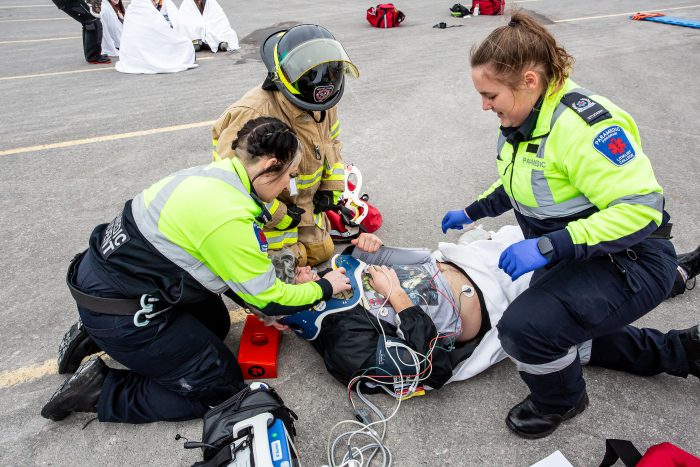
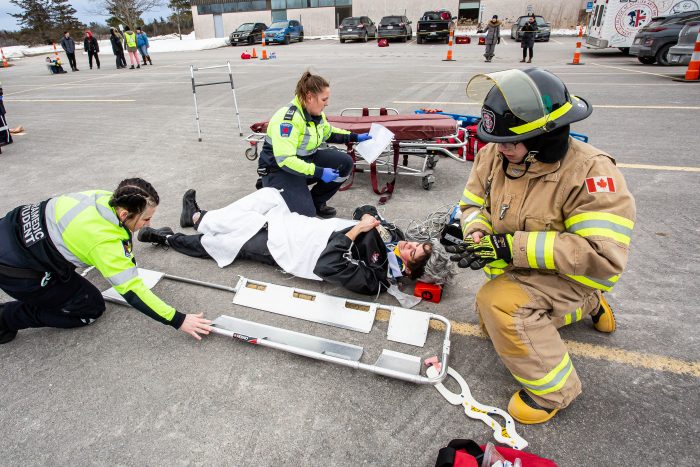
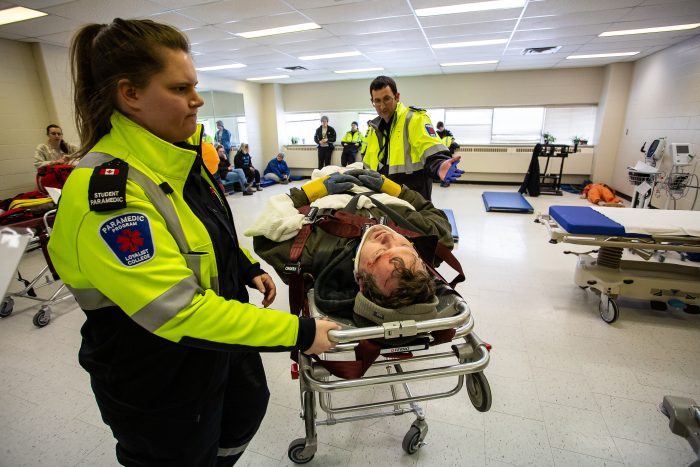
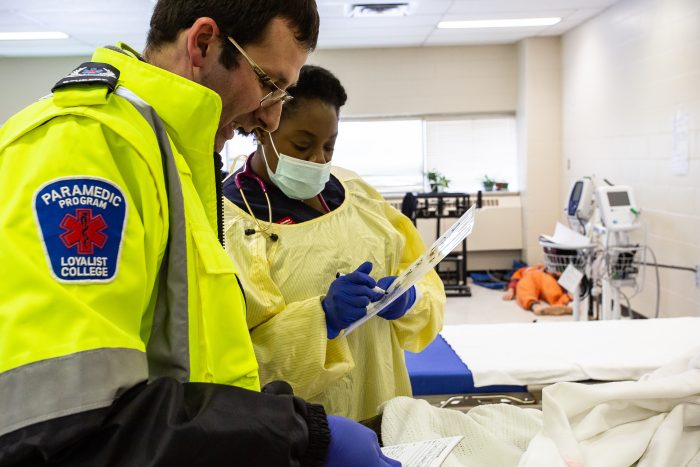
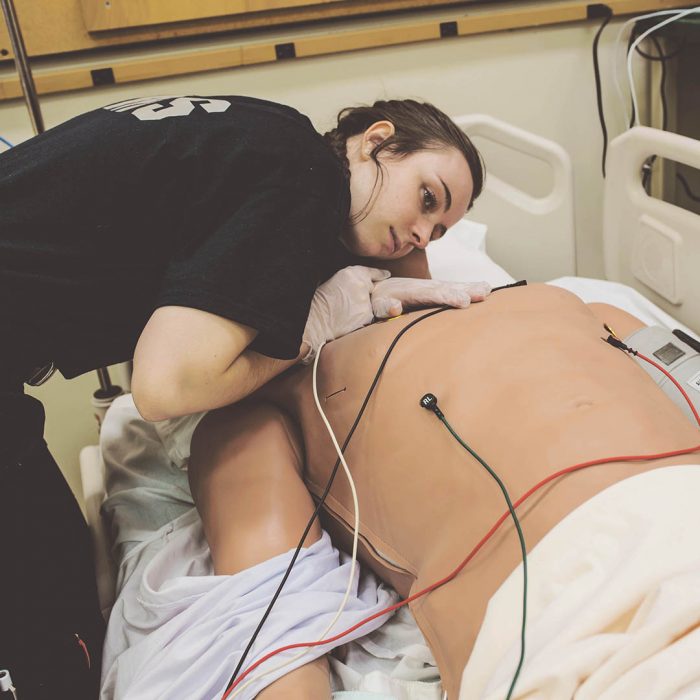
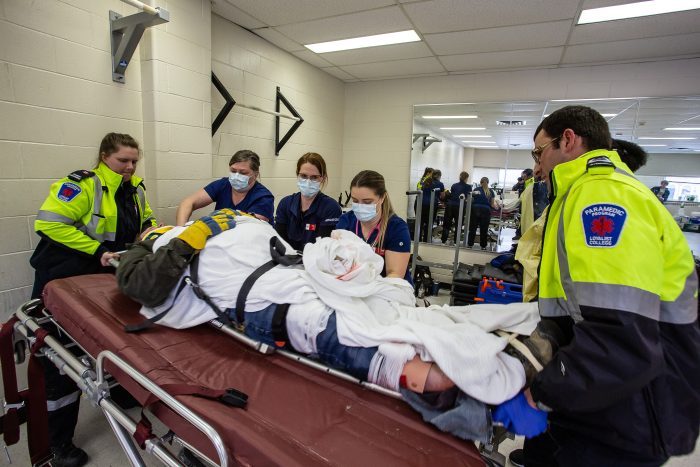
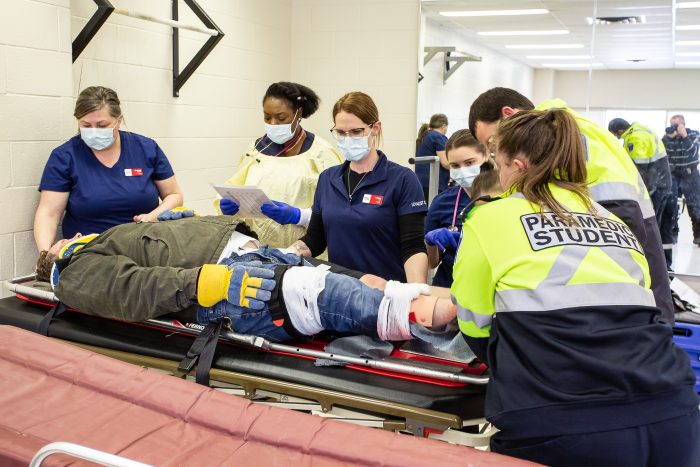
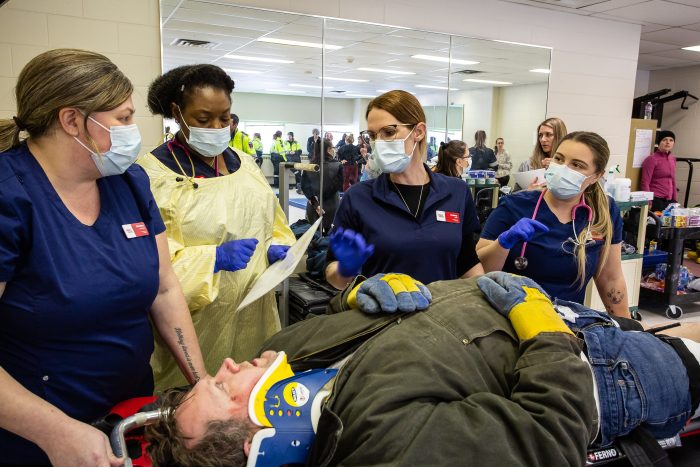
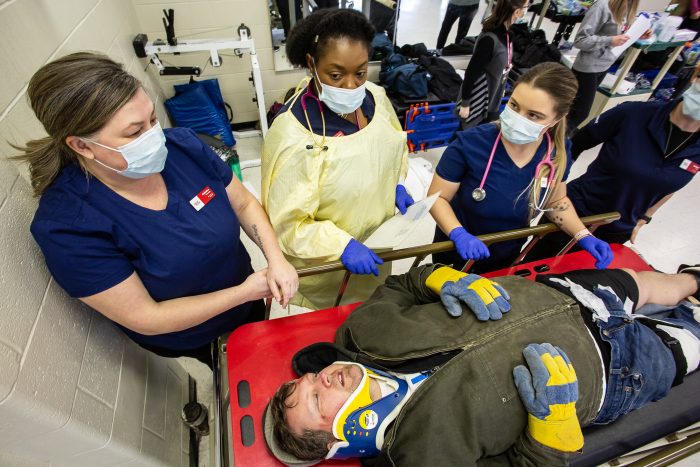
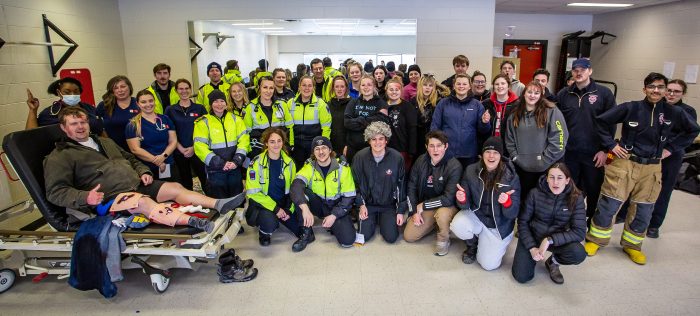
Paramedics are often the first people on the scene of an emergency. They balance compassion with critical decision-making skills and the ability to take command in a crisis and help save lives.
NOTE: This program is available to domestic students only.
Find your career
Graduates will find opportunities working as:
- Primary care paramedics in the ambulance system in Ontario, nationally or abroad.
- Emergency medical responders with municipal fire departments.
- Private ambulance transfer-service members.
- Health and safety educators in industrial settings.
- Grads are qualified to write the Advanced Emergency Medical Care Assistant (A-EMCA) exam offered by the Ministry of Health.
Our grads get great jobs
- Paramedic, City of Toronto
- Firefighter, Brampton Fire and Emergency Services
- Paramedic, Ministry of Health
- Paramedic, Hastings-Quinte EMS
Is it for you?
Have you got what it takes? You may be well suited to a career as a paramedic if you:
- Are seeking a challenge
- Can think on your feet
- Want a career where you can make a difference
- Have a clean driving record
What employers say
“We have hired many Loyalist graduates who work at Hastings-Quinte Paramedic Service in full-time and part-time positions. Loyalist’s high standards result in graduates entering the paramedic field as quality medics.”
John O’Donnell
Chief, Hastings-Quinte EMS
Experiential learning
Alternate Delivery
Loyalist is the only college in Ontario that offers a two-year Paramedic diploma through alternative delivery, through a combination of practical, clinical and classroom instruction.
- Alternate Delivery classes are held on alternate weekends (Saturdays and Sundays).
- Participate in live lectures through online delivery, weekday evenings and weekends on campus, and interact with professors and classmates from the comfort of your home.
Belleville Campus
Leveraging the best practices of paramedicine established from our Alternate Delivery offering, the Belleville campus is excited to offer a traditional Monday through Friday delivery model utilizing our state-of-the-art, interprofessional simulation centres and experienced faculty to deliver more options to the Belleville community and its future first responders.
- Enhance your learning and engage in 'real-life’ clinical situations with a variety of technology solutions.
- Access all of the resources and facilities available through a main campus experience.
Both programs offer the opportunity to be a part of immersive, experiential learning environments:
- Prepare to respond to emergencies and provide life support measures in simulated and clinical placement situations ranging from urgent to emergent care situations.
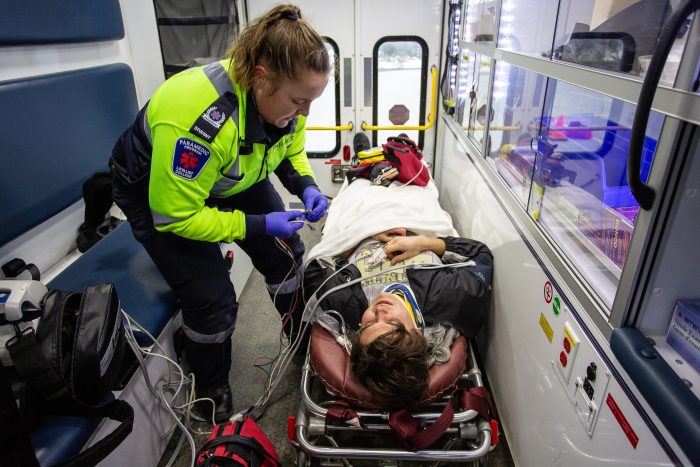
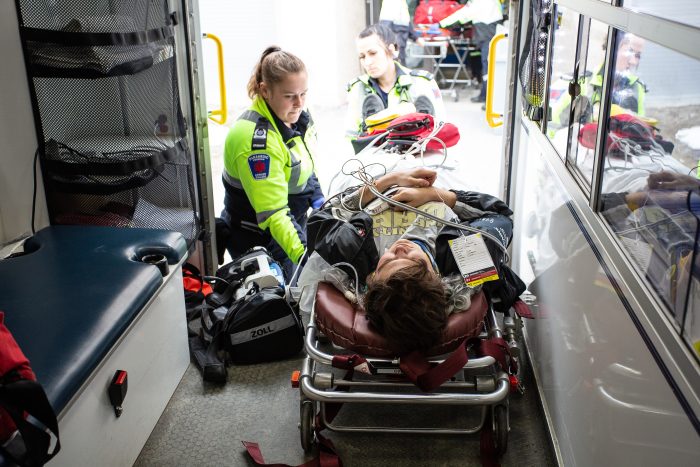
- Learn to administer care in a variety of environments associated with paramedicine, in the field or in a moving ambulance.
- Learn to drive an ambulance through simulated technology as well as actual, supervised road time.
- Experience the job first hand during 450 hours of supervised ride-out in an ambulance.
Outstanding faculty make the difference
- Curriculum is continuously reviewed and enhanced by instructors who work full time in the field as members of the allied health care team and are experts in their field of study, including basic, advanced, and critical care paramedics.
- Real-world emergency scenarios come to life in the classroom as faculty relate their experiences on the job to that week’s lesson.
- Professors come from across the province and have a depth of experience, bringing the real world of paramedicine into the classroom.
- First Year - Semester One
- ANAT1006 Anatomy & Physiology
-
This course provides the student with essential knowledge of the structure and function of the human body. This knowledge will allow the student to understand the mechanisms of various physiological conditions and to comprehend the principles underlying medical interventions devoted to maintaining or improving a patient’s condition.
- PMED1015 Crisis Intervention
-
In the course, the student will be introduced to the various principles of human behaviour through a study of good mental health, stress and coping behaviours, through theoretical and practical concepts necessary for intervening in crisis situations and psycho-social behavioural outcomes. Special emphasis will be on crisis intervention, burn out and suicide, including the dynamics of anger and hostility.
- PMED1019 Emergency Patient Care 1
-
This course provides the knowledge and skill to establish the priorities of assessment and treatment for those patients in crisis due to the effects of illness/trauma. The resulting pathophysiological manifestations are assessed to identify the degree of crisis/life threat and appropriate interventions per the paramedic scope of practice are implemented and evaluated for effectiveness of care provision.
Co-requisite: ANAT 1006, FITN 1006
- FITN1006 Fitness 1
-
This course provides the student with essential knowledge of physical fitness, wellness and nutrition. Principles of fitness training are introduced and practised through group and individual activity. Special emphasis is placed on occupation-specific lifting devices, safe lifting techniques and proper lifting ergonomics.
Co-requisite: PMED 1019
- PMED1014 Medical Ethical Issues
-
This course is designed to help the student better understand the various complex aspects of the legal and ethical implications of performing pre-hospital care. This course is focused on the Acts applicable to the paramedic in the performance of their duty and the associated governing sections of those Acts as they apply to the pre-hospital setting. Legal implications of patient care, as it applies to the pre-hospital setting, will be discussed and explored in the context of ethical decision making.
- GNED1100 Becoming a Global Changemaker
-
This Loyalist College graduate attributes course will help shape your perspectives, broaden your understanding of important issues affecting our societies today, and equip you with invaluable knowledge and skills that will inform your ability to influence your community in a meaningful and impactful way. By exploring topics such as cultural competency, Indigenous education, entrepreneurship, sustainability, health and wellness, and ecological literacy, you'll be equipped with a powerful toolkit that extends far beyond the classroom.
- First Year - Semester Two
- PMED1008 Advanced Skills for Primary Care Paramedics 1
-
The emphasis of this course is on critical thinking related to advanced cardiac assessment, interpretation of assessment findings and their implications for patient management. The student will understand and deliver the Ministry of Health EHSB protocols (ALSPCS) for Semi-Automatic External Defibrillation, the use of current pre-hospital defibrillators, and lead II rhythm interpretation.
Prerequisite: ANAT 1006, PMED 1019
Co-requisite: PMED 1018
- PMED1018 Emergency Patient Care 2
-
This course builds on the foundational skills and assessments developed in PMED 1019. Students will develop the knowledge and skills required to identify and manage patients who are experiencing crisis due to illness, trauma or medical condition and further refine their abilities to determine appropriate interventions that align with the paramedic scope of practice, while continuously evaluating treatment and care to ensure that care remains patient-centred.
Prerequisite: PMED 1015, ( PMED 1007 or PMED 1019
Co-requisite: PMED 1008
- PMED1009 Emergency Vehicle Maintenance & Operations
-
In this course, students learn techniques to ensure driver and vehicle readiness for emergency service. Students acquire skills to maintain emergency vehicles, prepare and operate emergency vehicles, and drive defensively, avoiding hazards and controlling skids.
- FITN1007 Fitness 2
-
Students continue to develop physical fitness and lifestyle management strategies in preparation for a career in the paramedic field. Principles of fitness training, with an emphasis on cardiovascular, muscular strength/endurance, and flexibility are emphasized. Students engage in a variety of fitness, nutrition and stress management activities designed to enhance overall wellness. Lifting mechanics and proper patient transfer techniques are assessed.
Prerequisite: FITN 1006
- PMED1017 Pathophysiology
-
This course is designed to familiarize students with the groundwork and understanding of pathophysiological processes that lead to the varying medical and traumatic conditions which students are taught to manage in Emergency Patient Care.
Prerequisite: ANAT 1006
- PHAR1005 Pharmacology
-
This course focuses on basic pharmacology with a special emphasis on drugs used in the treatment and management of pre-hospital care.
Prerequisite: ANAT 1006
- GNED General Education Elective
- General Education Courses
- Second Year - Semester Three
- Second Year - Semester Four
- PMED2013 Paramedic Comprehensive Review
-
Students consolidate key concepts of pre-hospital care. Course participants relate and integrate theoretical concepts previously learned with clinical situations. Challenges of the student-to-paramedic transition will be thoroughly discussed. Students receive feedback following a comprehensive evaluation of their theoretical and practical skills.
Co-requisite: WKPL 2081
- WKPL2081 Paramedic Field Experience
-
This course provides an overall review of the core concepts of paramedicine and pre-hospital care. It will correlate the concepts of clinical, field care and theory and its application to the patient. It will correlate the concepts of clinical, field care and theory and its application to the patient while working as part of a paramedic crew in an ambulance.
Prerequisite: PMED 2021, PMED 2024, PMED 2027, PMED 2028, PMED 2029
Co-requisite: PMED 2013
*Courses subject to change.
Turn your diploma into a degree
Many universities across Canada and abroad will provide credit recognition for your diploma studies at Loyalist College. The following is a list of agreements that are currently in place. There are many more options, and new agreements are added annually. Contact your university of choice to make individual arrangements. Click here for more information about university transfer agreements.
- Algoma University — B.A.; B.B.A.; B.Sc.; Bach. Computer Science
- Brock University — various*
- Davenport University – B.A. Health Services Administration or Public Safety and Security Management
- Lakehead University — various*
- Laurentian University — various*
- Laurier Brantford – any honours program
- Nipissing University — various*
- Seneca College — Bach. Interdisciplinary Studies
- Ontario Tech University – Bach. Allied Health Science (Honours); B.A. Adult Education and Digital Technology
- University of Waterloo — various
- Wilfrid Laurier University — various*
- York University — various*
*Various potential degree pathways. Please confirm details with the receiving institution.
How much will it cost?
Approximate costs (2023 – 24)
- Domestic Tuition: $2,722.08
- Full-Time Ancillary Fees:* $1,308
- Total: $4,030.08
- Additional Program Costs: $1,550 (books for year one)
- Students must provide an iPad, iPod Touch or iPhone (or Android) meeting minimum College requirements.
Additional costs, such as supplies, travel and parking, may be incurred during workplace visits, etc.
*Fees related to programs that are less than or greater than two semesters will be adjusted accordingly. Fees are subject to change. Please visit the Tuition and Fees web page for a list of the many services, activities and items included within the ancillary fees, and the related policies.
Bursaries and financial assistance
Loyalist has a number of scholarships, bursaries and academic awards available to students. Our Financial Aid Office can help you explore your options, or assist you with a student loan.
Admission requirements
NOTE: This program is available to domestic students only.
Required academic preparation
OSSD/OSSGD or equivalent with courses at the general, advanced, (C), (U) or (M) level with:
- Grade 12 English (C) level or equivalent
- Grade 11 or 12 Biology AND
- Grade 11 or 12 Chemistry
OR
- Recognized Ontario College Pre-Health program
OR
Additional requirements upon entry
- Driver Abstract, Full Class G upon entry, Class F prior to graduation.
Additional requirements prior to first clinical
- Up-to-date tetanus and diphtheria, polio, measles, mumps, rubella, varicella (chicken pox), Hepatitis B (incl. Hep B within the last 24 months) and TB skin test.
- Standard First Aid and CPR HCP certification.
- Criminal Record Check and Vulnerable Sector Check. (Certain criminal convictions may prevent participation in placements and program completion may not be possible).
- Paramedicine is a physically demanding profession. It is strongly recommended that all applicants have a high level of fitness. Students will be required to successfully complete comprehensive lifting and fitness evaluations in the first and second year to be successful in the program.
Additional requirements
Upon completion of this program, graduates must be successful in a theoretical examination set by the Ministry of Health, Emergency Health Services Branch, Ontario in order to be certified as a paramedic and thus to be eligible to work in an ambulance service in Ontario. The cost for the examination process is the responsibility of the graduate.
Strongly recommended academic preparation
- Grade 11 or 12 Math (C) or equivalent
Prior learning assessment and recognition
Applicants with work experiences or other types of non-credentialed learning may be eligible for credits at Loyalist. Graded credits (as opposed to exemptions) are granted. Click here for more information about our assessment and credit challenge process.
Campus News
LOYALIST COLLEGE STUDENTS ADMINISTER COVID-19 VACCINES AT BELLEVILLE C...
 Belleville, Ontario, May 13, 2021 – Loyalist College students began administering COVID-19 vaccines at the College’s Immunization Centre this week. Directed by Hastings Prince Edward Public Health... Read More
Loyalist College Paramedic Graduate adapts to life at the front lines
College graduates are facing a very different work environment in 2020.
Like many recent graduates, Bailey Meraw found her new workplace dramatically altered by COVID-19. In Meraw’s case, as a para... Read More
LOYALIST COLLEGE PARAMEDIC GRADUATES ACHIEVE 100 PERCENT SUCCESS
Belleville, Ontario, December 13, 2017 – Loyalist College 2017 Paramedic graduates were 100 percent successful in their Advanced Emergency Medical Care Assistant (A-EMCA) exams offered by the Minis... Read More
LOYALIST COLLEGE RECOGNIZES HASTINGS COUNTY FOR PROVIDING TRAINING VEH...
Belleville, Ontario, March 31, 2016 — Loyalist College is pleased to recognize Hastings County for the generous donation of a decommissioned ambulance, to be used in Loyalist’s two-year Paramed... Read More
Kawartha Credit Union Annual Bursary Benefits Loyalist Students in Ban...
On August 28, 2013, Tina Doucet, Manager of Kawartha Credit Union’s Bancroft branch, presented a $5,000 cheque to Jim Whiteway, Dean, School of Business, Continuing Education, Bancroft Camp... Read More
In the News
QNet News
InQuinte
Northumberland News
Bancroft This Week
County Live