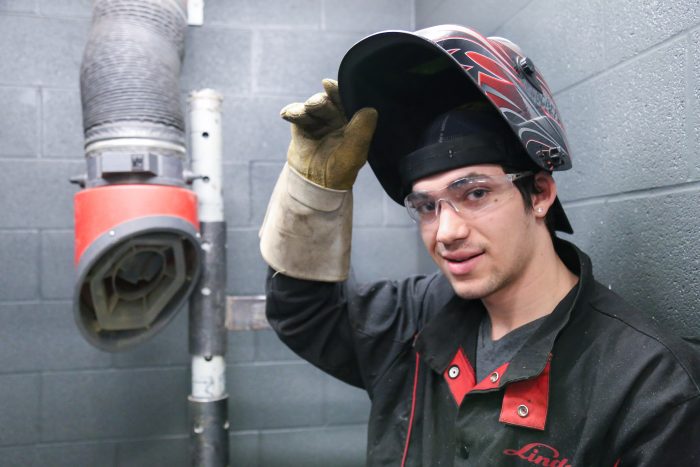
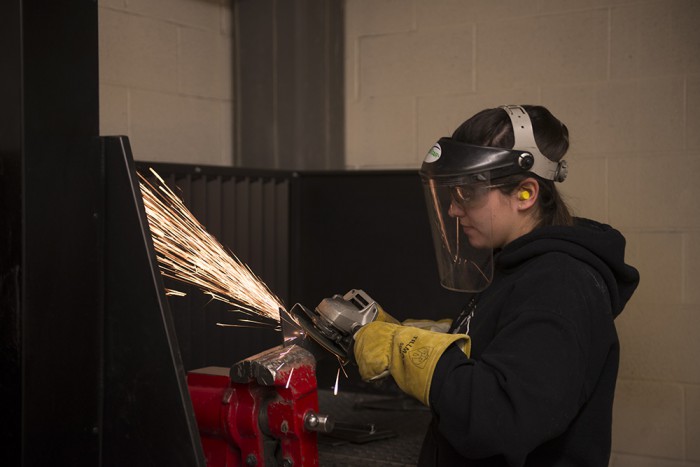
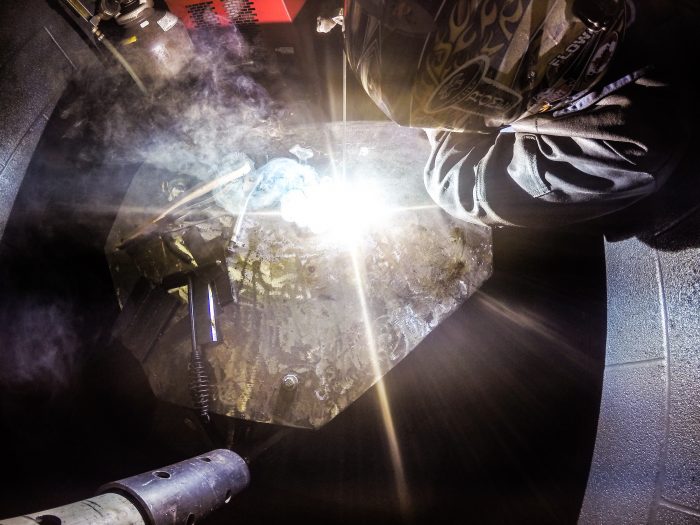
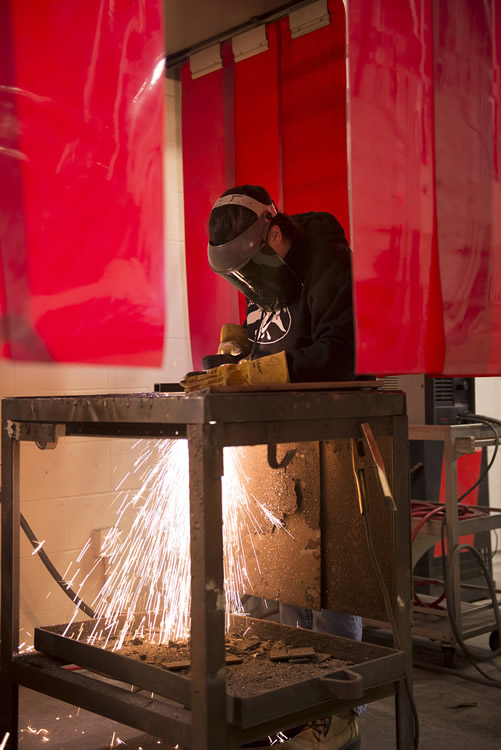
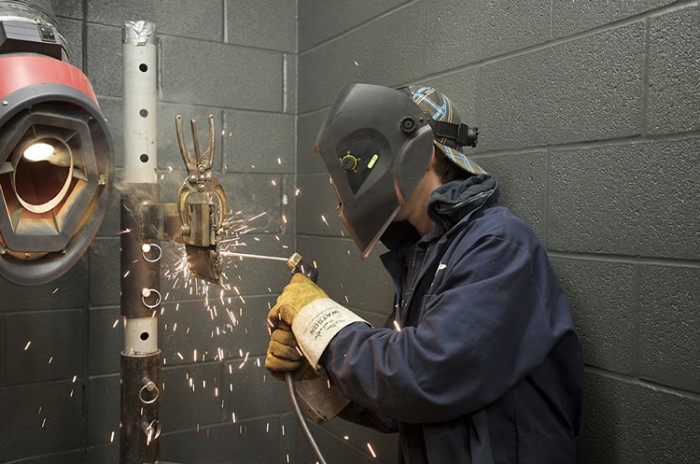
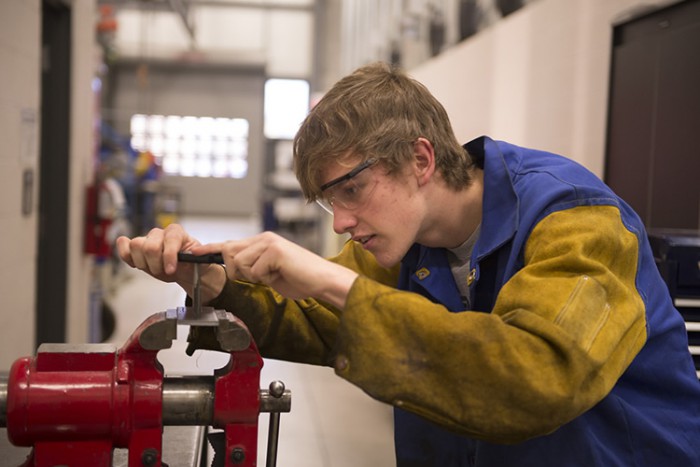
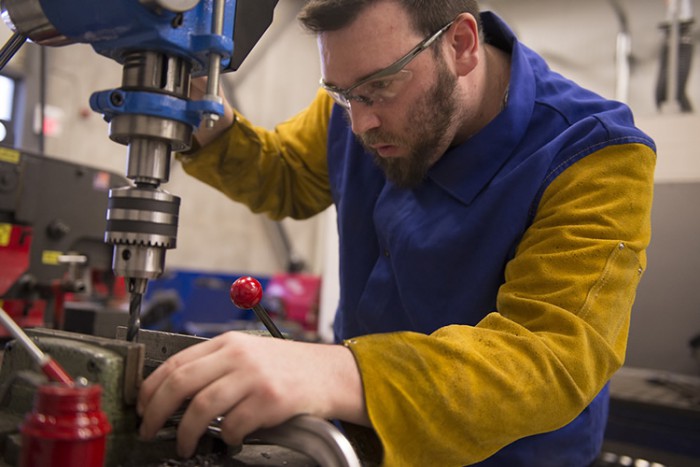
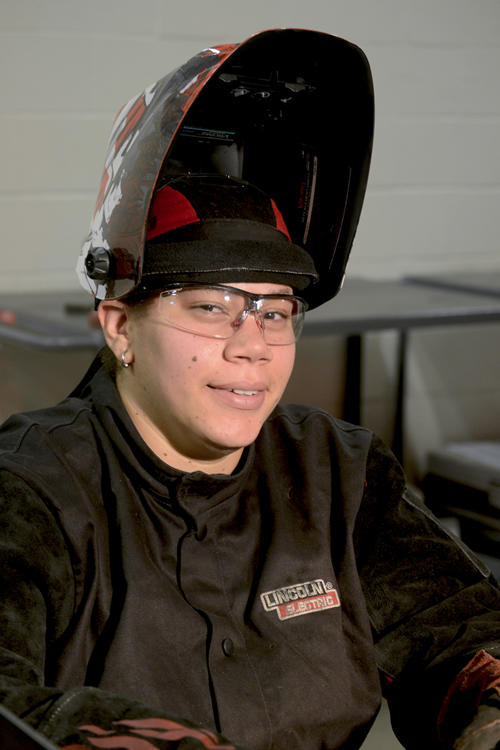
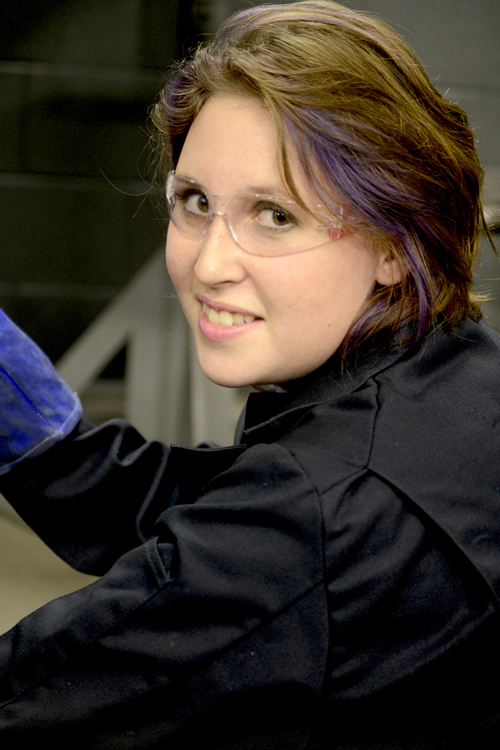
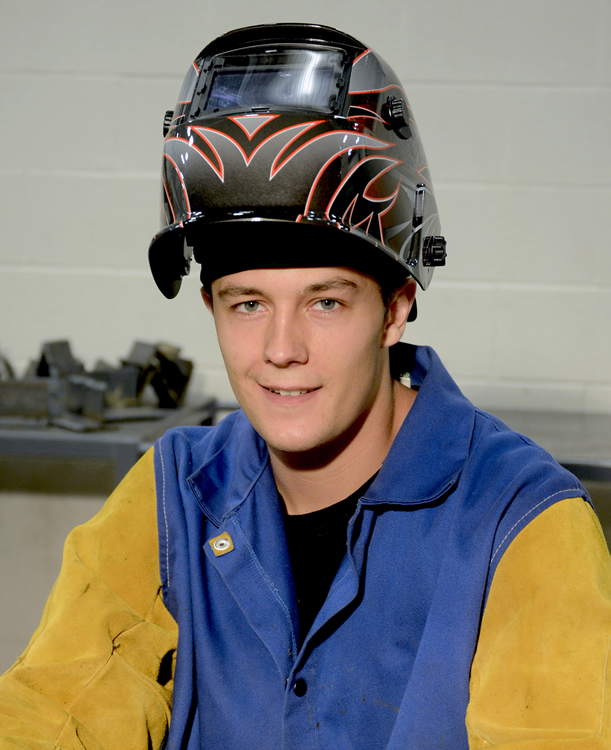
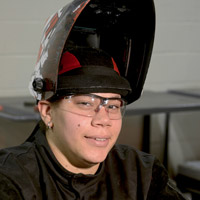
A chain is only as strong as its weakest link. The precision work of welders and fabricators holds up bridges and delivers miners safely underground. Gain skills in welding, fabrication, detailing and millwrighting that you can use across the country, from coast to coast, in virtually any industry.
Find your career
As a welder/fabricator technician, you will find job opportunities in any industry where metal fabrication and maintenance are performed. Your new skills can take you anywhere:
- You could work in manufacturing, construction, welding or inspection.
- Fabricate mining equipment; machinery; pipelines; bridge truss systems; vehicles such as subway cars and fire trucks; or shipbuilding and aerospace.
- Average starting salaries range from $40,000 to $44,999*. With experience and government certification, potential earnings increase to $60,000 and more.
- Get an employment edge with certificates you can earn in the program, such as Certified Welder, Structural Steel Plate Fitter, Certified Welding Inspector or Welding Supervisor.
- You could fast track into an apprenticeship.
*Source: Employment Profile Provincial Report, Ministry of Colleges and Universities.
Our grads get great jobs
- Technical Advisor, Voith Hydro Inc.
- Welder, Durose Manufacturing Limited
- Welder/Setter, L-3 Communications
- Welder/Fitter, North American Steel
- Level 2 Welding Inspector, Canadian Welding Bureau
- Thermite Welding, Canadian Pacific Railway
- Production/Welding, Honda Canada
- Welder/Fabricator, Material Handling Systems
- Welder/Fabricator, Timmins Trailers
- Welder/Fabricator, McCloskey International Ltd.
Is it for you?
Welders play an essential role in building and maintaining critical infrastructure. This is a good career for people who:
- Show precision in their work.
- Have solid math skills.
- Take pride in doing things right.
- Would like to master a skill that will be in demand wherever they go.
Experiential learning
Prepare to meet increasingly complex industry standards through hands-on learning in Loyalist’s newly equipped The Bay of Quinte Skills Centre:
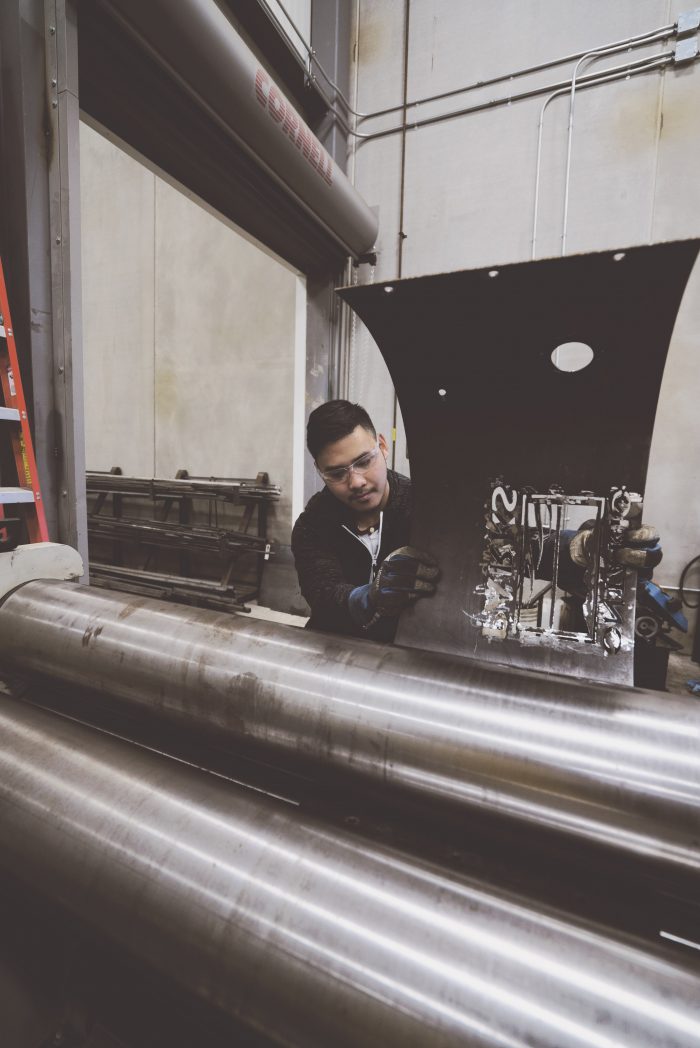
- Follow projects from the engineering drawings stage, through cutting and forming processes, to the completion of the job and quality inspection.
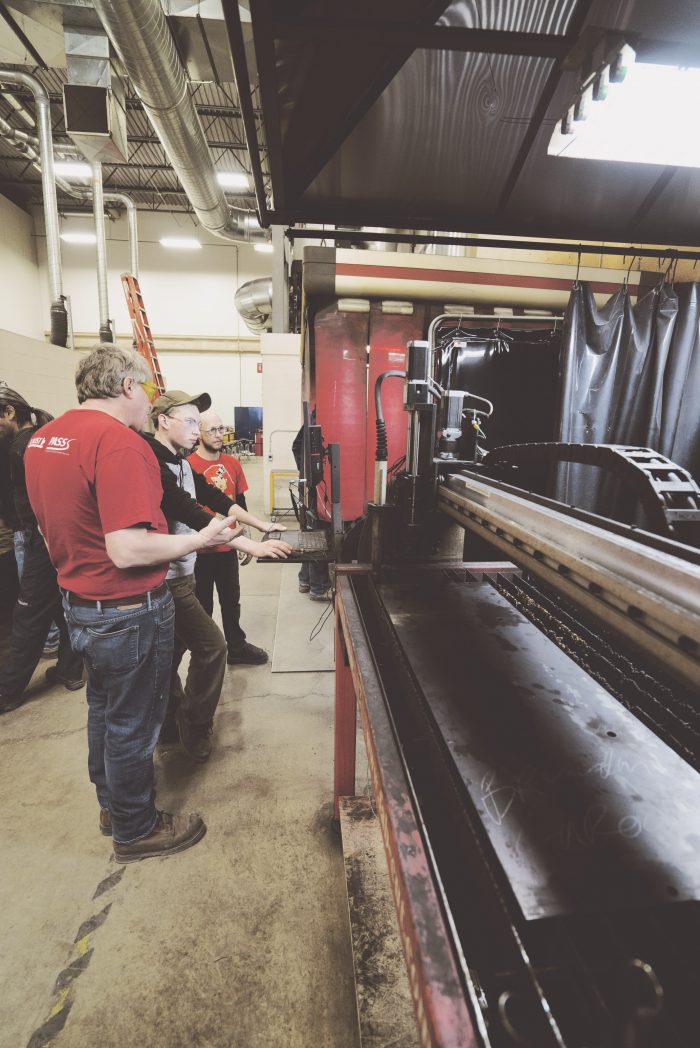
- Create with new and evolving technologies such as CNC press brakes, CNC plasma cutting and 3D designing.
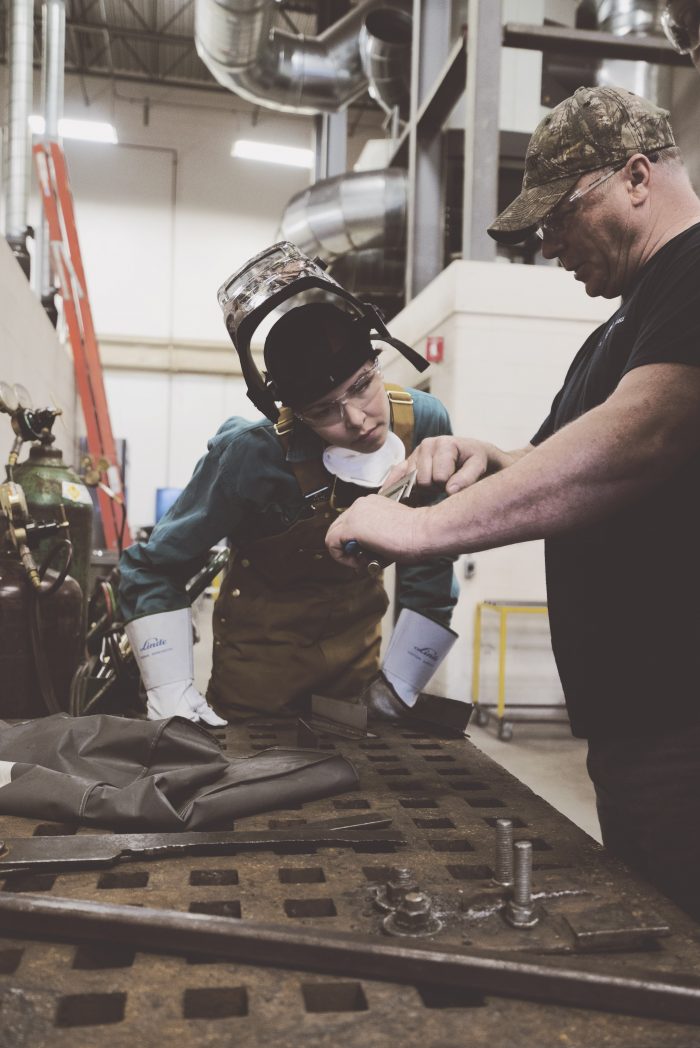
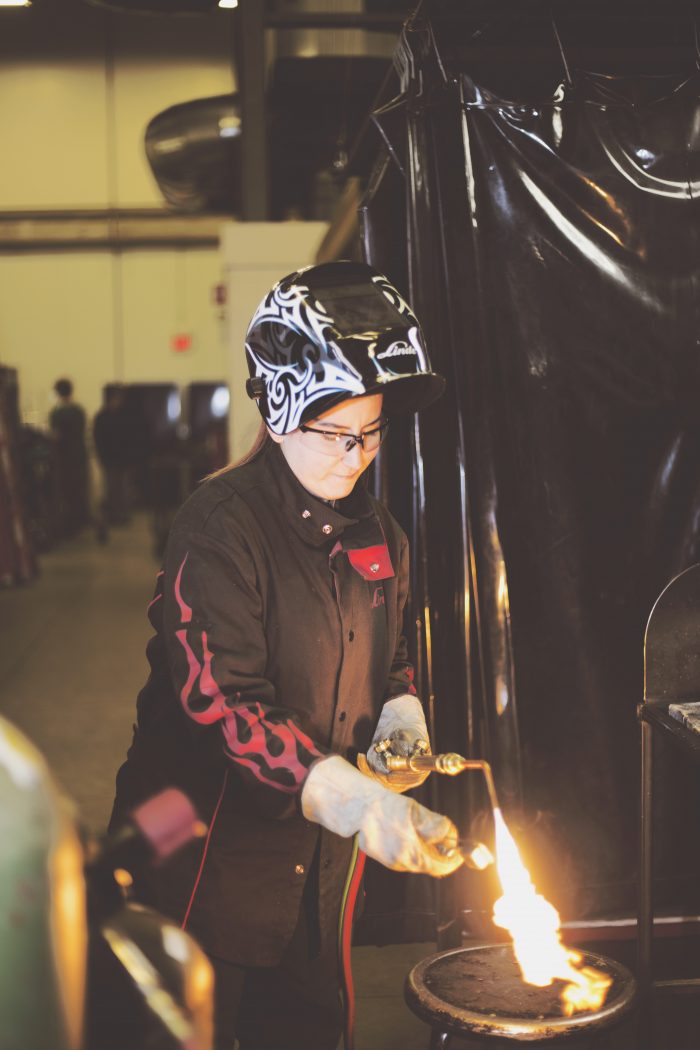
- Practise welding techniques such as gas metal arc welding, shielded metal arc welding and gas tungsten arc welding.
- Participate in the Ontario Skills Competition and field trips to the Canadian Manufacturing Technology Show.
- Expand your theoretical and practical skill set, along with in-depth trade practices and job planning skills, in the two-year diploma program.
You can obtain certification with the Canadian Welding Bureau for the following welding certificates in Loyalist’s on-site test centre:
- Gas Metal Arc Welding (G.M.A.W.) Flat Position
- Gas Tungsten Arc Welding Steel (G.T.A.W.) Fillet
- Gas Tungsten Arc Welding Stainless Steel (G.T.A.W.) Fillet
- Gas Tungsten Arc Welding Aluminum (G.T.A.W.) Fillet
- Shielded Metal Arc Welding (S.M.A.W.) Four Positions
- Flux Cored Arc Welding (F.C.A.W.) Flat Position
- Metal Cored Arc Welding (M.C.A.W.) Flat Position
- Welding Inspector Certificate and Welding Supervisor are also offered through the Canadian Welding Bureau Centre for Learning (part of the C.W.B. Group)
Outstanding faculty make the difference
- Learn in bright, well-equipped facilities with dedicated faculty
- Professors include a Red Seal Structural Plate Fitter and proceeding officer with the Canadian Welding Bureau
- Teachers have a vast network of industry contacts to help connect students with jobs
- First Year - Semester One
- COMP1017 Computer Applications
-
Students are introduced to Microsoft applications such as Outlook (email), PowerPoint, Microsoft Word and Excel. Students learn how to use the Internet and understand the use of a maintenance management system. Within the course, students are equipped with job searching techniques, interview skills and will prepare a cover letter and résumé.
- WELD1013 Fitting 1
-
Students focus on the use and application of equipment, tools, fasteners and processes used in fabrication practices in the welding industry. Students will interpret plans for the actual fabrication of small projects. Students will develop techniques for layout, fitting, squaring, tacking and fabricating.
- WELD1012 Layout 1
-
Students focus on the use and application of describe objects in a mechanical form, drafting standards under the International Organization for Standardization (ISO) and the Canadian Standards Association (CSA). Students will develop techniques for understanding and reading blueprints as they relate to the fabricating industry.
- SAFE1003 Occupational Health & Safety
-
Students learn the rights and responsibilities of the various stakeholders under the Occupational Health and Safety Act (OHSA). Specific topics associated with the four main types of hazards found in workplaces (physical, biological, ergonomic and chemical) are covered. Where possible and practical, in addition to theory-based classes, students are involved in practical hands-on activities. WHMIS legislation is also introduced.
- MATH1027 Technical Math 1 (WELT)
-
In this course, students demonstrate basic analytical skills and they are prepared for further studies in mathematics. Topics include basic number systems and operations, units and measurement, basic algebraic operations, geometry and solving word problems.
- WELD1000 Welding 1
-
This course focuses on various fabrication processes. Oxyacetylene welding, brazing, cutting, Shielded Metal Arc Welding (SMAW) and Gas Metal Arc Welding (GMAW) in various positions will be covered. Students will also study safety procedures and electrode identification.
Co-requisite: SAFE 1003, WELD 1001
- WELD1001 Welding Theory 1
-
Students learn an introduction to the theory and practice of welding, providing a strong background in the various fabrication processes. The course will cover oxyacetylene welding, brazing, cutting, G.M.A.W. (Gas Metal Arc Welding) and S.M.A.W. (Shielded Metal Arc Welding).
- First Year - Semester Two
- WELD1014 Fitting 2
-
Students learn the advanced interpretation of drawing and symbols for the actual fabrication of large projects. Techniques for layout, fitting, squaring, tacking, welding and fabricating will be practiced.
Prerequisite: WELD 1013, SAFE 1003
- WELD1011 Layout 2
-
Students learn the advanced interpretation of drawings and symbols for fabrication. This course also introduces students to computer-aided design using AutoCAD.
Prerequisite: WELD 1012
- WELD1006 Metallurgy 1
-
This course focuses on studying different metals and how they react to welding, distortion and stress. Students examine types of steel and the proper welding methods and electrode filler metals to be used. Different destructive and non-destructive testing will be performed along with an introduction to welding inspection.
- MATH1028 Technical Math 2 (WELT)
-
Students consolidate the skills in arithmetic, algebra, solving equations, trigonometry and graphical analysis to solve problems used in technological applications.
Prerequisite: MATH 1027 or MATH 1026
- WELD1003 Welding 2
-
Students will get an introduction to Metal Core Arc Welding (MCAW), Gas Shielded Fluxed Core Arc Welding (FCAW-G) and Gas Tungsten Arc Welding (GTAW). In addition, students will continue to study Shielded Metal Arc Welding (SMAW). Students will also learn about Canadian Welding Bureau Certification Tickets and will have the opportunity to practise using a range of processes in various positions.
Prerequisite: WELD 1000, SAFE 1003
- WELD1004 Welding Theory 2
-
Students are introduced to Flux-Cored Arc Welding and Metal-Cored Arc Welding, Shielded Metal Arc Welding of groove welded joints, robotics, automation, and production welding processes. Classification of weld faults, weldability of alloys, and welding codes and standards are explored. Students participate in the discussion and calculation of structural steel cutting processes.
Prerequisite: WELD 1001
- GNED1100 Becoming a Global Changemaker
-
This Loyalist College graduate attributes course will help shape your perspectives, broaden your understanding of important issues affecting our societies today, and equip you with invaluable knowledge and skills that will inform your ability to influence your community in a meaningful and impactful way. By exploring topics such as cultural competency, Indigenous education, entrepreneurship, sustainability, health and wellness, and ecological literacy, you'll be equipped with a powerful toolkit that extends far beyond the classroom.
- Second Year - Semester Three
- COMM2020 Applied Communication
-
In this course, students will refine the skills acquired in Applied Communication by preparing responses to a variety of work-related situations, including writing memos, letters and reports.
- BUSI2015 Business Start Up
-
This course provides an overview of business in the Canadian environment using an integrated model. Topics include: the environment of business (social, technological, economic and political) as well as functional areas of business (marketing, accounting, finance, production and human resources) and legal and corporate governance information. A semester-long group project will provide students with the opportunity to explore the world of business and build skills related to researching a company and current issues and trends in the business world.
- WELD2012 Computer-Aided Pattern Development
-
In this course, students will develop and produce flat patterns of various shapes for the purpose of steel fabrication using PlasmaCAM software. They will also build on the knowledge and skills obtained in Layout and Fitting 1 & 2, adding new skills in the fabrication of shop projects. Shop projects of increasing difficulty will meet the demands set by industry and supplement the skills acquired. Students will be able to differentiate between types and characteristics of structural shapes and members. They will also be able to read and interpret structural drawings, structural standards and structural steel and plate terminology. Time may be spent in both the classroom and shop to aid in the familiarization of the required course material.
Prerequisite: WELD 1014, WELD 1011
- WELD2003 Welding 3
-
In this course, students will be able to demonstrate advanced skills in the use of welding and cutting equipment. They will build on their skills and competencies obtained in Welding 1 & 2.
Prerequisite: WELD 1003
- WELD2004 Welding Distortion and Inspection
-
In this course, students will be introduced to the principles of heat distortion and various means of reducing the negative effects that heat can have on different metals. They will identify which preventative measures are required during the welding and fabrication process to minimize heat distortion and post-welding straightening methods. Finally, the students will demonstrate process quality and describe methods of weld testing using NDT techniques such as industrial radiography using X-rays or gamma rays, ultrasonic testing, LPI and MPI methods.
- GNED General Education Elective
- General Education Courses
- Second Year - Semester Four
- WELD2005 Computer-Aided Steel Detail
-
In this course, students will learn how to utilize computer-aided detailing of various types of structures and elements of structures, constructing 3D models of various types of structures and creating orthographic drawings in Autodesk Inventor. From the 3D models, they will learn to create erection views, beam, columns and bracing details and gather drawings. Shop fabrication of the various elements will be discussed as well as erection procedures in the field.
Prerequisite: WELD 2000 or WELD 2012
- WELD2006 Fabrication & Assembly Practice
-
In this course, students increase their skills by fabricating complex weldments common to industry. They will complete their practical projects meeting tolerances and quality criteria set by industry.
Prerequisite: WELD 2003, ( WELD 2012 or WELD 2000 )
- WELD2008 Layout and Template Development IV
-
In this course, students will develop patterns for irregular tapered forms, square-to-round transitions and double-angle forms employing the triangulation method using layout instruments and mathematical calculations, as well as using CNC equipment to complete shop projects.
Prerequisite: WELD 2000 or WELD 2012
- WELD2009 Rigging, Installation and Job Planning
-
In this course, students will learn the process of site installation, including selection and safe operation of lifting and rigging equipment. Students will be able to plan a project to completion from the bid stage to site delivery.
- WELD2010 Welding 4
-
In this course, students will demonstrate a working knowledge of welding fillet and groove welds in the horizontal, vertical and overhead positions with the Flux Core Arc Welding (FCAW) and the Gas Tungsten Arc Welding process (GTAW).
Prerequisite: WELD 2003
- GNED General Education Elective
- General Education Courses
*Courses subject to change.
What’s next?
- With a certificate in Welding Techniques, you can progress directly into year two of the Welding and Fabrication Technician diploma.
- Expand your options with a double diploma in another College program in as few as two semesters.
- Fast track into an apprenticeship
- The skills and experiences you gain in Loyalist's two-year Welding and Fabrication Technician diploma program can help you jump-start your apprenticeship journey! Learn how.
- Information about qualification requirements leading to certification is available on the Ministry of Labour, Immigration, Training and Skills Development website. You can also contact an Employment Ontario apprenticeship office near you.
Turn your diploma into a degree
Many universities across Canada and abroad will provide credit recognition for your diploma studies at Loyalist College. The following is a list of agreements that are currently in place. There are many more options, and new agreements are added annually. Contact your university of choice to make individual arrangements. Click here for more information about university transfer agreements.
Two-year diploma
- Algoma University — B.A.; B.B.A.; B.Sc.; Bach. Computer Science
- Brock University — various*
- Lakehead University — various*
- Laurentian University — various*
- Nipissing University — various*
- Seneca College — Bach. Interdisciplinary Studies
- Ontario Tech University — B.A. Adult Education and Digital Technology
- University of Waterloo — various*
- Wilfrid Laurier University — various*
- York University — various*
*Various potential degree pathways. Please confirm details with the receiving institution.
Autodesk certification
Students are eligible to challenge the Autodesk certification exams at Loyalist College. Completing these industry-recognized credentials enables students to highlight that they have the in-demand skills employers are seeking.
How much will it cost?
Approximate costs (2023 – 24)
- Domestic Tuition: $2,722.08
- Full-Time Ancillary Fees:* $1,308
- Total: $4,030.08
- Additional Program Costs: $1,291 (year one)
Additional costs, such as supplies, travel and parking, may be incurred during workplace visits, etc.
*Fees related to programs that are less than or greater than two semesters will be adjusted accordingly. Fees are subject to change. Please visit the Tuition and Fees web page for a list of the many services, activities and items included within the ancillary fees, and the related policies.
- Second-year students can apply for funding through the Canadian Welding Association (CWA) Foundation Post-Secondary School Award.
Bursaries and financial assistance
Loyalist College has a number of scholarships, bursaries and academic awards available to students. Our Financial Aid Office can help you explore your options, or assist you with a student loan.

Students enrolling in this program may be eligible for the Schulich Builders scholarship program.
Schulich Builders covers tuition, tools and living expenses for students enrolling in a skilled trades program. Loyalist College will award ten scholarships per year:
- Five $20,000 scholarships for one-year certificate programs, and
- Five $40,000 scholarships for two-year diploma programs.
Admission requirements
Required academic preparation
- OSSD/OSSGD or equivalent with courses at the general, advanced, (C), (U) or (M) level, AND
- Grade 12 English (C) level or equivalent
OR
Recommended academic preparation
- Welding
- Grade 11 Mathematics
Prior learning assessment and recognition
Applicants with work experiences or other types of non-credentialed learning may be eligible for credits at Loyalist. Graded credits (as opposed to exemptions) are granted. Click here for more information about our assessment and credit challenge process.
International students
Click here for information about how to apply, international student fees and more.
Campus News
LOYALIST COLLEGE CALLS FOR APPLICATIONS FOR THE WESTON FAMILY SCHOLARS...
 Belleville, Ontario, August 2, 2018 – Loyalist College encourages prospective skilled trades students and apprentices to apply for The Weston Family Scholarship in the Skilled Trades by the deadline... Read More
LOYALIST COLLEGE SKILLS COMPETITION WINNERS ANNOUNCED
Belleville, Ontario, March 9, 2017 – Loyalist College is pleased to announce the winners of the 2017 Loyalist College Skills Competition. Over 80 competitors from five school boards competed on Tue... Read More
LOYALIST AND OTHER ONTARIO COLLEGES ARE LEADING THE FIGHT TO TACKLE CL...
Belleville, Ontario, October 13, 2016 – Ontario’s colleges are playing a leading role in Canada’s efforts to tackle climate change, says a newly released report.
The report, Moving to Net Zero... Read More
LOYALIST COLLEGE STUDENTS RECEIVE CANADIAN WELDING ASSOCIATION (CWA) F...
Belleville, Ontario, March 17, 2016 — Loyalist College is pleased to announce that two second-year Welding and Fabrication Technician students have received a Canadian Welding Association (CWA) Foun... Read More
LOYALIST COLLEGE TO HOST SKILLS COMPETITION FOR SECONDARY SCHOOL STUDE...
Loyalist College will host a Skills Competition on Tuesday, March 24 to provide more than 70 students in grades 10 and 11 with the opportunity to compete in the following skilled trades:Automotive Ser... Read More
In the News
InQuinte
InQuinte
Belleville Intelligencer
Belleville Intelligencer
Town of Lincoln