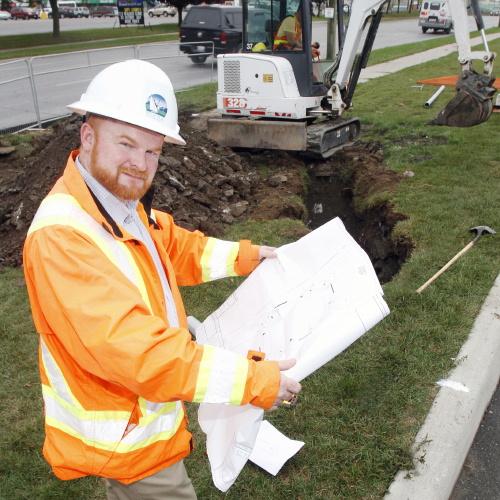
By integrating science and engineering concepts with industry-specific technologies, civil engineering technicians and technologists assist in the monitoring and inspection of civil infrastructure projects. An education in civil engineering can offer many opportunities – leading to rewarding careers both in the office and out in the field, in areas such as construction management, estimating and inspection as well as infrastructure design and drafting. By integrating science, engineering and sustainability concepts with industry-specific technologies, civil engineering technicians and technologists participate in the successful completion of civil infrastructure projects such as public transit, land development, municipal services and resource management.
Find your career
Our graduates are employed by:
- Municipalities and cities
- Consulting engineering firms
- Construction contractors
- Federal and provincial agencies
Prepare for high-demand positions in:
- Design and construction
- Interpreting and preparing specifications, drawings or instructions
- Infrastructure maintenance and rehabilitation
- Project estimating (quantities and costs)
- On-site quality assurance
- Project management or supervision
- Graduates are eligible for certification with the Ontario Association of Certified Engineering Technicians and Technologists (OACETT).
- Average starting salaries range from $40,000 to $49,999.*
*Source: Employment Profile Provincial Report, Ministry of Advanced Education and Skills Development.
Our grads get great jobs
- Public Works Manager, Augusta Township
- Building Inspector, City of Belleville
- Highway Inspector, Highway Construction Inspection Ontario
- Estimator, Cornerstone Builders
- Network Coordinator, Bell Canada
Is it for you?
This career holds rewarding opportunities for students who:
- Like to know how things work.
- Want to make a lasting difference in the community.
- Are good at visualizing problems in order to tackle solutions.
- May prefer to work indoors or outdoors.
Experiential learning
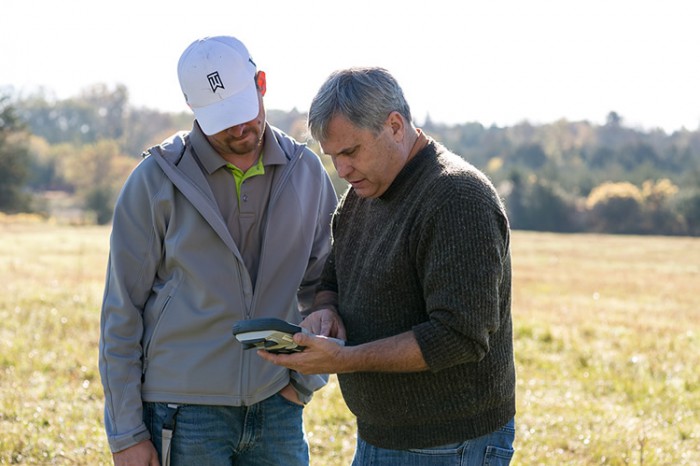
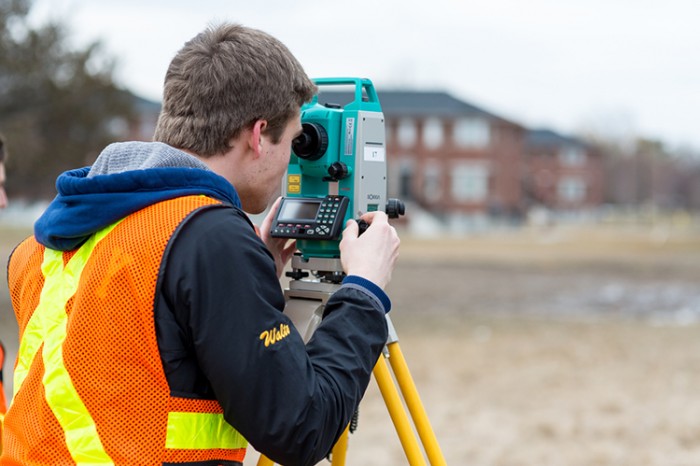
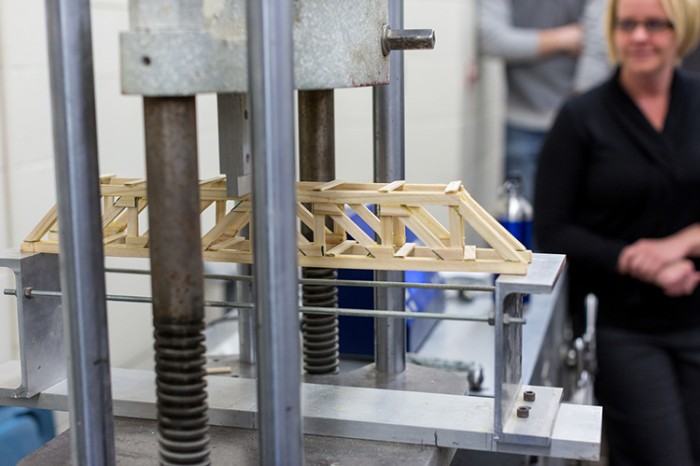
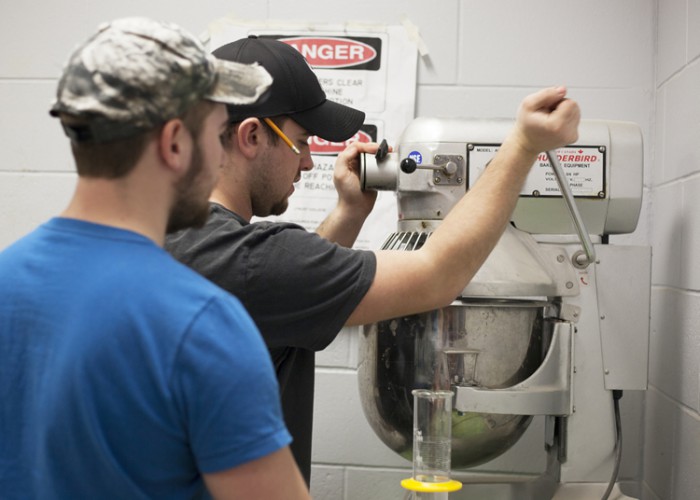
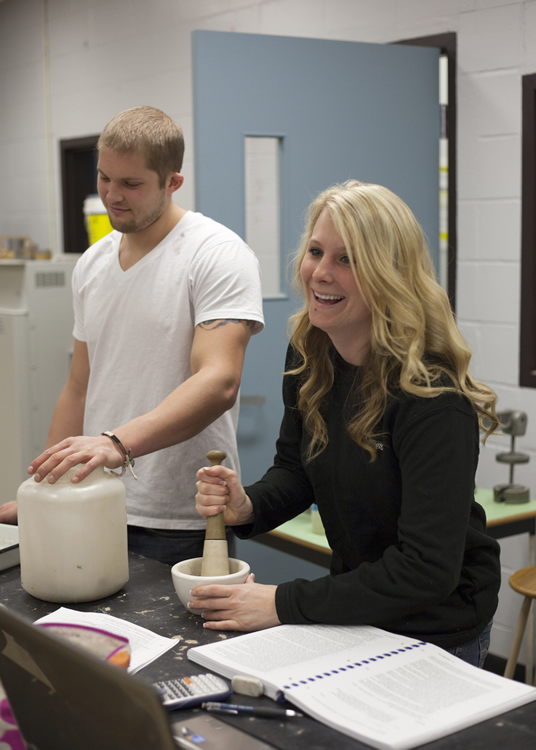
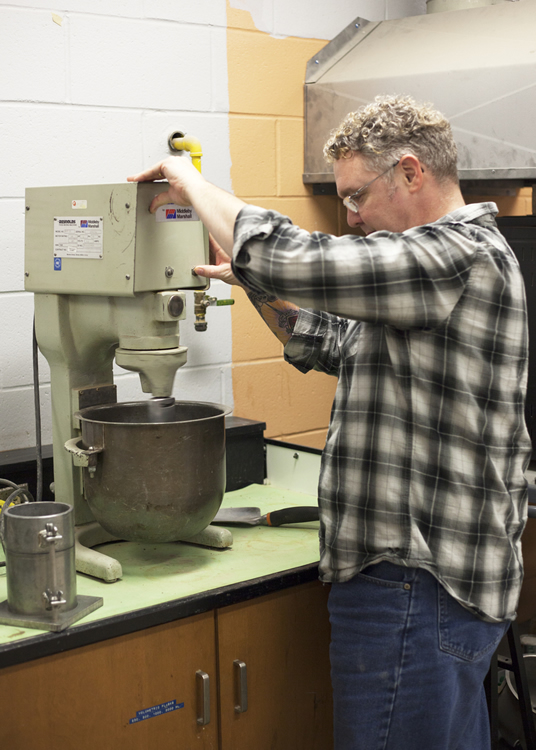
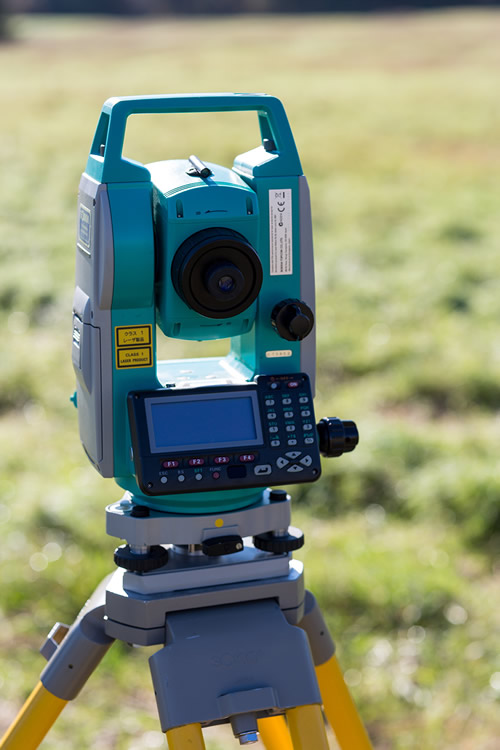
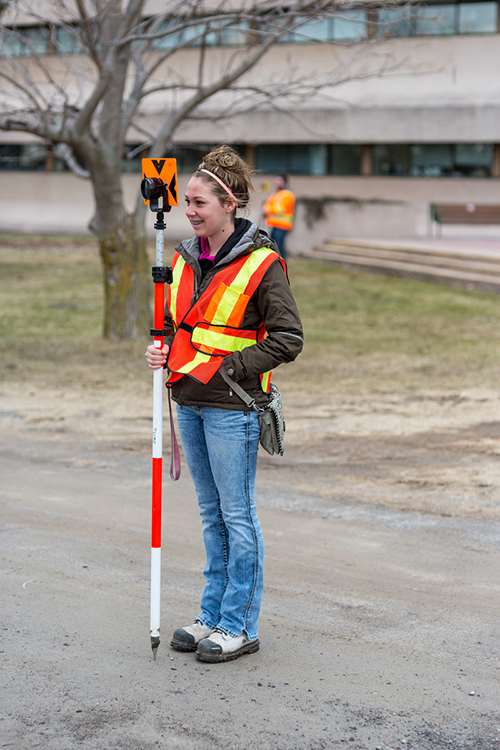
This well-rounded program combines classroom instruction, hands-on learning, both outside (in the field) and inside, in our Building Sciences Lab using industry-standard equipment.
Outstanding faculty make the difference
- Receive lots of personal attention from professors with over 25 years of experience in municipal and transportation engineering.
- Learn from an industry leader in the development of Geographic Information Systems (GIS), working with global organizations using GIS technology to support sustainable development.
- First Year - Semester One
- BLDG1005 Building Methods & Materials
-
This course deals with materials used in buildings, and the methods and equipment used in constructing with these materials. Materials include: concrete, masonry, wood and steel.
- CADD1004 CAD 1
-
Cad 1 is an introductory course in 2-D computer aided drafting, using the AutoCAD program. The initial focus of the course is to learn and implement basic commands to create, edit, store and retrieve data. This skill and knowledge is developed through basic, simple drawing assignments. Another component of the course is dedicated to developing print reading skills as related to construction documentation.
- COMP1003 Engineering Applications
-
Students are introduced to Microsoft Office software. The basics of Microsoft Word are learned and Microsoft Excel is used with engineering applications.
- SURV1000 Geomatics 1
-
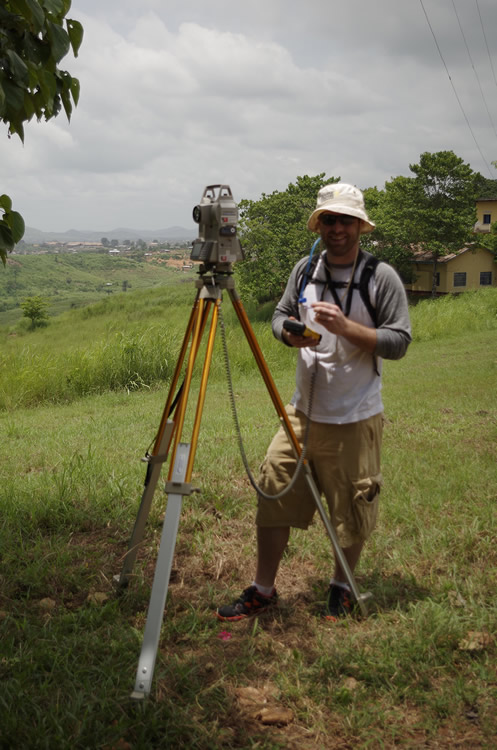
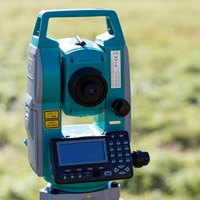
Geomatics 1 is the first of three courses in surveying offered in the Building Sciences Program and introduces the learner to the survey technologist's/technician's role in communicating land-related information between stakeholders in Architectural/Engineering/Construction (AEC) projects. This dialog is dependent upon the efficient and accurate measurement of angles, distances and differences in elevations and the careful recording of the data gathered. Learners will explore the theory of making measurements during classroom lectures and develop the practical skills of operating automatic levels, total stations, electronic data-collectors, and GPS receivers during weekly field exercises.
- MATH1012 Math 1
-
Students learn to use the mathematical tools that are required in their engineering subjects. Building sciences applications of algebra, geometry and trigonometry are emphasized.
- First Year - Semester Two
- CADD1005 CAD 2
-
CAD 2 is an extension of CAD1. The objective of this course is to further enhance student's knowledge of the AutoCAD software. Having developed an understanding of basic functions such as geometry creation, editing, dimensioning and annotation, students learn more advanced features of the software to facilitate drawing creation and organization, primarily in a 2-D setting. This will be accomplished by the use of more involved, complex and discipline related projects. A component of the course will also include print reading fundamentals with construction drawings.
Prerequisite: CADD 1004 or TECH 8150
- BLDG1004 Heavy Construction, Methods and Materials
-
This course deals with materials used in civil engineering works, and the methods and equipment used in construction with these materials. Materials include: soils, concrete, steel, heavy timber, and asphalt.
- SURV1001 Highway Technology 1
-
This course introduces the learner to the geometry of Canadian highways and how various factors such as design speed, climate, traffic flow, and vehicle characteristics affect the properties of proposed roads. Candidates will apply the skills and mathematical techniques introduced in Mathematics 1 and Geomatics 1 to calculate the minimum radius of a highway, determine appropriateness of introducing transition curves, deciding if and when to alter the cross-section of the roadway, when to insert vertical curves, and how to prepare information to control the construction of a roadway.
Prerequisite: MATH 1012, SURV 1000
- MATH1007 Mathematics 2
-
This course is a continuation of Mathematics 1.
Prerequisite: MATH 1012
- BLDG1003 Statics
-
This course deals with the effects of external forces on rigid bodies at rest. The first half of the course concentrates on forces and equilibrium. The second half deals with applications of basic principles to specific structural shapes (trusses, beams).
Prerequisite: MATH 1012
- COMM1002 Technical Communications 1
-
Students develop communication skills for the presentation of technical information in business documents that meet the needs of clients and customers. Documents and presentations are produced in Word and PowerPoint.
- GNED1100 Becoming a Global Changemaker
-
This Loyalist College graduate attributes course will help shape your perspectives, broaden your understanding of important issues affecting our societies today, and equip you with invaluable knowledge and skills that will inform your ability to influence your community in a meaningful and impactful way. By exploring topics such as cultural competency, Indigenous education, entrepreneurship, sustainability, health and wellness, and ecological literacy, you'll be equipped with a powerful toolkit that extends far beyond the classroom.
- Second Year - Semester Three
- SURV2000 Geomatics 2
-
This course is about engineering and construction surveying. It introduces the student to the major steps of surveying within an engineering project - setting up project control, completing topographic surveys including breaklines for terrain modeling, producing, transferring and extracting information with digital media, staking out alignment and grades for construction work. Advanced geomatics concepts such as ellipsoid, geoid, datum, projections, grids, and survey adjustments are introduced. Students become proficient at using total station equipment for pickup and layout and develop confidence in the accuracy and precision of various measuring methods. AutoCAD Civil 3D is used to develop terrain and simple road corridor design used in the stakeout.
Prerequisite: SURV 1001, COMP 1003
- BLDG2006 Highway Technology 2
-
This course introduces students to principles involved in the design, construction, and operations of roads and highways in Ontario, building on the basic knowledge gained in Geomatics, Computer Applications, and AutoCAD courses. Topics include road classification, level of service, interpreting topography, drainage requirements, and advanced highway geometry. AutoCAD Civil 3D is introduced to support highway design using Civil 3D Surface, Alignment, Profile, Assembly, and Corridor objects.
Prerequisite: SURV 1001, COMP 1003, CADD 1005
- BLDG2008 Materials Testing 1
-
Students obtain hands-on experience in a materials testing laboratory setting, and become familiar with the mechanical properties of construction materials using CSA/ASTM standard test methods.
Prerequisite: BLDG 1005, COMP 1003
Co-requisite: BLDG 2005
- MUNI2000 Municipal Services 1
-
This course introduces fundamental design concepts of municipal services/engineering to students. Topics include hydraulics of pipes and channels, hydrology (precipitation and runoff), water demand, sewage generation, sewer network design and conveyance, and design of individual building servicing. Also included are references to design guidance from local Municipal, Provincial, and Federal (and other) regulatory agencies.
Prerequisite: MATH 1007, CADD 1005
- BLDG2005 Strength of Materials
-
This courses focuses on concepts of stress, strain, tension, compression, shear, bending and mechanical properties of materials as they relate to the building industry are discussed.
Prerequisite: BLDG 1003, MATH 1007
- BLDG2004 Structural Drafting
-
Students learn the general requirements for structural steel design drawings and shop detail drawings. Drawing projects will include beam shop details and bracing details.
Prerequisite: CADD 1005
- GNED General Education Elective
- General Education Courses
- Second Year - Semester Four
- BLDG2013 Contracts, Specifications and Estimating
-
Students study the various forms of contracts used in the construction industry. The style, purpose and method of writing specifications are studied. Using the contract, specifications and drawings, students prepare estimates of quantities of materials and construction costs for residential and industrial buildings.
- BLDG2014 Materials Testing 2
-
This course is a continuation of Materials Testing 1.
Prerequisite: BLDG 2008
- MUNI2001 Municipal Engineering 1
-
Using Autodesk Civil 3D this course teaches the principals and processes for the creation of municipal road, drainage, and services. Students will select a parcel of land and, through the course materials – lectures, demonstrations, text, standards, examples, tutorials, and assignments – produce an urban municipal subdivision design.
Prerequisite: BLDG 2006
- BLDG2009 Soil Mechanics
-
The behaviour of soil and produced aggregates used in construction processes are studied through a combination of practical and theoretical methods. The material properties necessary to anticipate this behaviour are determined through application of standardized laboratory test procedures.
Prerequisite: COMP 1003
- BLDG2010 Strength of Materials 2
-
Strength of Materials 2 is a continuation of Strength of Materials 1. Students solve problems related to elementary strength of materials topics. This course is a further study of the effects of loads on building components. The deflection of beams and behaviour of columns are also studied.
Prerequisite: BLDG 2005
- BLDG2011 Structures
-
Students study the primary types of structures and their component elements, dead and live loads, which can be applied to a structure. Using limit state design concepts, loads acting on members are determined, and structural elements sized.
Prerequisite: BLDG 2005
- GNED General Education Elective
- General Education Courses
- Third Year - Semester Five
- MATH2003 Calculus
-
This course covers the fundamentals of differential and integral calculus. Calculus plays an important role in the understanding of science, engineering, economics, and business. This introductory calculus course covers differentiation and integration of one variable, with applications.
Prerequisite: MATH 1007
- BLDG3015 Concrete Design
-
Soil mechanics are used to make the selection and design of typical foundations.
- BLDG3006 Construction Supervision 1
-
Students study the role of the construction superintendent with special emphasis on leadership, labour relations, construction management and safety at the site level.
- SURV3000 Geospatial and Environmental Analysis
-
This course introduces students in Civil Engineering Technology and Environmental Technology to the concepts, techniques and applications of geographic information systems. The focus is a fundamental understanding of data acquisition, mapping and spatial analysis. Practical examples related to transportation, environmental and geotechnical engineering will be provided to improve student learning and provide hands-on experience.
Prerequisite: MATH 1012 or MATH 1003
- BLDG3004 Steel Design 1
-
The applicable codes and standards, types and properties of structural steel and Limit States Design principles are introduced. Simple structural tension, compression and bending members are designed and detailed.
Prerequisite: BLDG 2010, BLDG 2011
- BLDG3003 Theory of Structures
-
This course undertakes the study of determinate and indeterminate structures subjected to various structural loadings such as gravity, wind, seismic and temperature loads.
Prerequisite: BLDG 2010, BLDG 2011
- Third Year - Semester Six
- BLDG3011 Construction Supervision 2
-
This course is a continuation of Construction Supervision 1.
Prerequisite: BLDG 3006
- MUNI3000 Municipal Engineering 2
-
New course - description to follow.
- BLDG2016 Reinforced Concrete Design
-
In this course the design of structural members made of steel-reinforced concrete is begun. Structural members are designed to satisfy the requirements of the CAN 3-A23.3-M84. Simple beams are used experimentally to show how reinforced concrete resists bending and shear.
Prerequisite: BLDG 2010, BLDG 2011
- BLDG3007 Steel Design 2
-
Students study the design of steel beams, columns and connections in accordance with the requirements of the CAN-S16.1-M89. Complex connections, build-up members, plate girders, and multi-storey frames are also examined.
Prerequisite: BLDG 3004
- COMM3000 Technical Report
-
This course introduces students to the methods and procedures used in writing a detailed technical report. This affords the student the opportunity to defend their technical report in an oral presentation.
Prerequisite: COMM 1002
- WATR3000 Water & Waste Water Treatment
-
New course - description to follow.
Prerequisite: MATH 1007
*Courses subject to change.
Flexible learning at Loyalist College
- With many common courses during the first-year curriculum, you have the flexibility to transfer directly into year two of the Survey Technician program (with some additional courses) or Construction Engineering Technician program
- You can graduate after two or three years
- Expand your qualifications and earn a double diploma in another College program in as little as two semesters
Turn your diploma into a degree
Many universities across Canada and abroad will provide credit recognition for your diploma studies at Loyalist College. The following is a list of agreements that are currently in place. There are many more options, and new agreements are added annually. Contact your university of choice to make individual arrangements. Click here for more information about university transfer agreements.
Two or three-year diploma
- Algoma University — B.A.; B.B.A.; B.Sc.; Bach. Computer Science
- Athabasca University — B.Sc.
- Brock University — various*
- Cape Breton University — various*
- Davenport University – B.A. General Business
- Griffith University — various*
- Lakehead University — various* — Bach. of Engineering in Civil
- Laurentian University — various*
- Limerick Institute of Technology – Bachelor of Science (Honours) in Civil Engineering Management (Year 4)
- Nipissing University — various*
- Ryerson University — various*
- Seneca College — Bach. Interdisciplinary Studies
- Ontario Tech University — various* — B.A. Adult Education and Digital Technology
- University of Waterloo — various*
- Western University — various*
- Wilfrid Laurier University — various*
- York University — various*
- Atlantic Technological University - Year 3 BEng in Civil Engineering
Three-year diploma
- Lakehead University – B.Eng.
- Laurentian University – B.Sc. Liberal Science
- McMaster University – B.Tech. Civil Engineering Infrastructure Technology
- Queen's University — various*
- Ontario Tech University – B.A.Sc. Nuclear Power Bridge; Commerce Bridge
- University of Windsor – B.Eng. Tech.
- Atlantic Technological University - BEng (Hon) in Civil Engineering (Add-On)
*Various potential degree pathways. Please confirm details with the receiving institution.
Professional certification
College graduates must apply to the Ontario Association of Certified Engineering Technicians and Technologists (OACETT) to be certified in Ontario. Loyalist Civil Engineering Technician and Technologist graduates meet the academic requirements for accreditation as a Certified Technician (C.Tech.) or Certified Technologist (C.E.T.). Applicants are also required to:
- Complete additional work experience
- Provide peer references
- Pass a Professional Practice Examination administered by OACETT, offered four times a year
- Write a Technology Report (for C.E.T. certification)
Study abroad
Explore opportunities to continue your studies in Ireland:
Autodesk certification
Students are eligible to challenge the Autodesk certification exams at Loyalist College. Completing these industry-recognized credentials enables students to highlight that they have the in-demand skills employers are seeking.
How much will it cost?
Approximate costs (2023 – 24)
- Domestic Tuition: $2,722.08
- Full-Time Ancillary Fees:* $1,308
- Total: $4,030.08
- Additional Program Costs: $670
Additional costs, such as supplies, travel and parking, may be incurred during workplace visits, etc.
*Fees related to programs that are less than or greater than two semesters will be adjusted accordingly. Fees are subject to change. Please visit the Tuition and Fees web page for a list of the many services, activities and items included within the ancillary fees, and the related policies.
Bursaries and financial assistance
Loyalist has a number of scholarships, bursaries and academic awards available to students. Our Financial Aid Office can help you explore your options, or assist you with a student loan.

Students enrolling in this program may be eligible for the Schulich Builders scholarship program.
Schulich Builders covers tuition, tools and living expenses for students enrolling in a skilled trades program. Loyalist College will award ten scholarships per year:
- Five $20,000 scholarships for one-year certificate programs, and
- Five $40,000 scholarships for two-year diploma programs.
Admission requirements
Required academic preparation
- OSSD/OSSGD or equivalent with courses at the general, advanced, (C), (U) or (M) level, AND
- Grade 12 English (C) level or equivalent
OR
Recommended academic preparation
- Grade 11 & 12 Math (MCF 3M & MCT 4C)
Prior learning assessment and recognition
Applicants with work experiences or other types of non-credentialed learning may be eligible for credits at Loyalist. Graded credits (as opposed to exemptions) are granted. Click here for more information about our assessment and credit challenge process.
International students
Click here for information about how to apply, international student fees and more.
Campus News
LOYALIST COLLEGE CALLS FOR APPLICATIONS FOR THE WESTON FAMILY SCHOLARS...
 Belleville, Ontario, August 2, 2018 – Loyalist College encourages prospective skilled trades students and apprentices to apply for The Weston Family Scholarship in the Skilled Trades by the deadline... Read More
LOYALIST COLLEGE TO OFFER DEGREE PROGRAMS THROUGH LIMERICK INSTITUTE O...
Belleville, Ontario, May 4, 2018 – Graduates of numerous Loyalist College two- and three-year diploma programs now have the opportunity to earn a degree in as little as one academic year through ad... Read More
LOYALIST COLLEGE INTRODUCES HORTICULTURE TECHNICIAN APPRENTICESHIP
Opportunity for Apprentices to Cultivate Landscaping Careers in the Bay of Quinte RegionBelleville, Ontario, May 12, 2016 – Loyalist College has received approval from the Ministry of Training, Col... Read More
Loyalist College Appoints Ann Drennan As Dean Of Applied Sciences, Ski...
Belleville, Ontario, July 11, 2013 - Loyalist College is pleased to announce Ann Drennan as the new Dean of the School of Applied Sciences, Skills and Technology effective August 26, 2013.
Ann bring... Read More
Skilled Trades and Technology Subject Experts Available For Media Inte...
Belleville, Ontario, February 28, 2013 – Loyalist College is pleased to provide a list of College professors who can comment on key topics related to skilled trades and technology. Each one of these... Read More
In the News
Kingstonist
InQuinte
Belleville Intelligencer
Belleville Intelligencer
Toronto Sun
Plan of subdivision final project
- Great Thrills Subdivision
- Designed by: Stephen Decaro
Download PDF
Highway design project
- Shannonville Road Extension
- Designed by: Ben Andreas and Jenna Maio
Download PDF