Find your career
- Students are prepared to work in radio, television, newspaper, magazine and online newsrooms.
- Graduates find work as writers, reporters, photographers, editors, freelancers, web content providers, editorial assistants, videographers, program hosts and news anchors.
- The skills developed in this program can also lead to careers in public and media relations, and educational, training or industrial video production.
- Average starting salaries range from $35,000 to $39,999.*
*Source: Employment Profile Provincial Report, Ministry of Training, Colleges and Universities.
Our grads get great jobs
- Anchor/Reporter, CTV News Kitchener-Waterloo
- Kingston Editor, Fine Lifestyles and Fine Homes
- Multimedia Journalist, Kingston Whig-Standard
- Content Producer, Station 14, Kingston
- Multimedia Journalist, Metroland Media Group Ltd.
- Anchor/Reporter, Quinte Broadcasting Ltd.
- Reporter/Photographer, Sun Media/Postmedia Network
- Announcer/Reporter, Moose FM Bancroft
- Reporter/Anchor, CTV News Winnipeg
- Staff Writer, ETCanada.com
Is it for you?
Journalists often walk a complex line between getting a story first, and getting it right. To succeed in journalism, you need:
- An inquisitive mind
- Strong writing and storytelling skills
- The ability to work to tight deadlines
- Perseverance
What employers say
“CHEX Television is happy to host Loyalist Journalism students each year. We find them to be enthusiastic, engaged and ready to take on whatever the day brings. Quite often the students are so well prepared for a career in journalism, they end up working for us after completing their internship! Our newsroom is filled with Loyalist grads.”
Lisa MacDonald-Lowe
Assignment Producer, CHEX-TV
Experiential learning
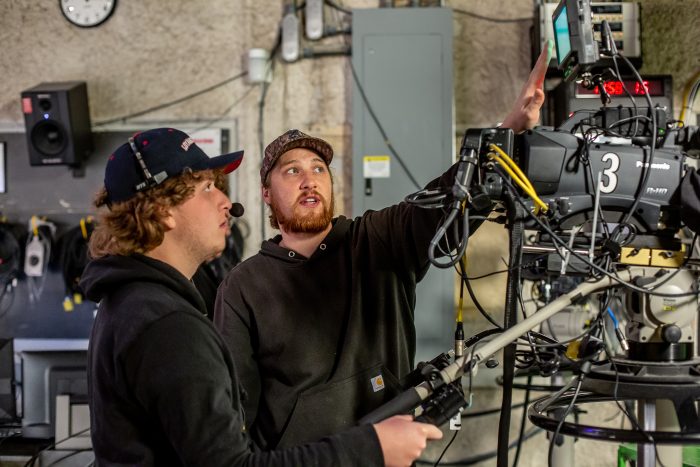
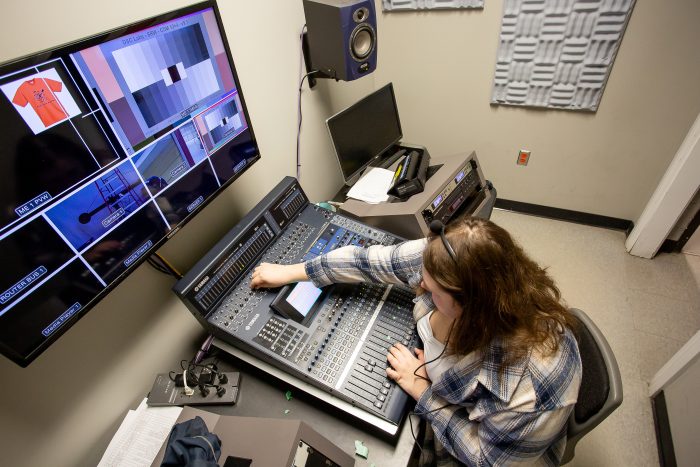
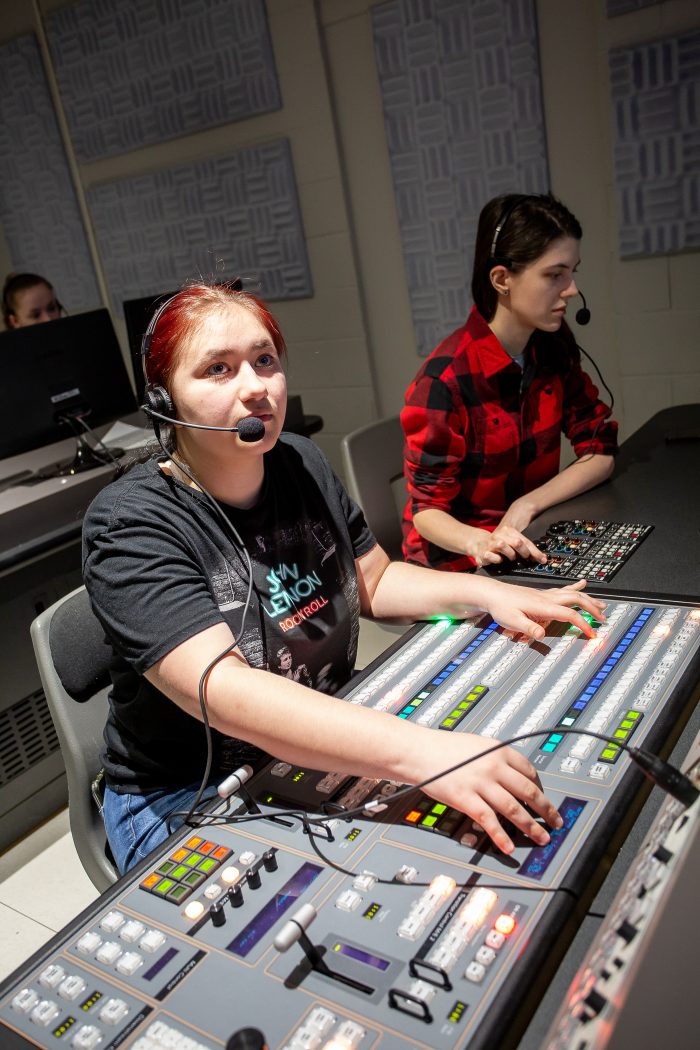
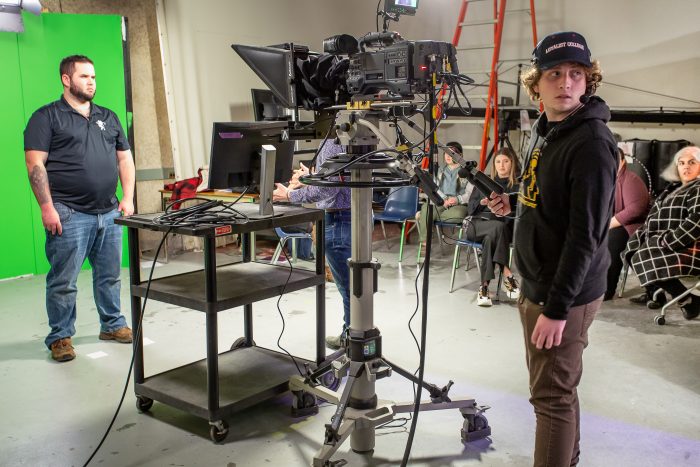
Get a well-rounded set of skills in our all-platform newsroom in Loyalist’s new Digital Media Centre. You will:
- Develop hands-on skills in research, writing and interviewing.
- Use digital tools and apps for gathering and sharing stories, video, social media and interactive journalism.
- Create newscasts for the federally licensed College radio station, 91X.
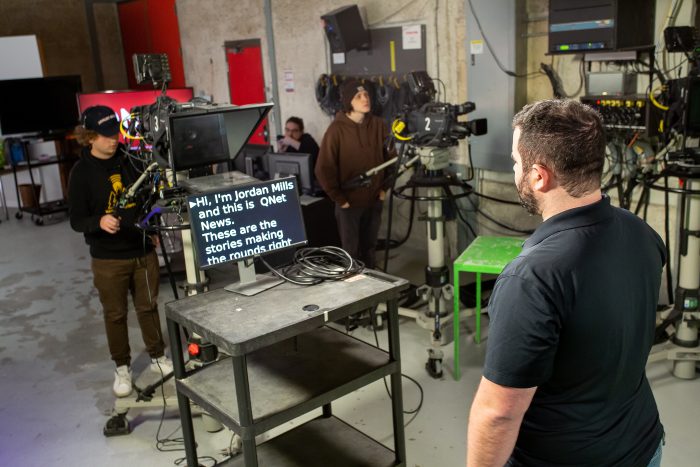
- Work with a team of student reporters, ENG shooters, producers, anchors and editors to produce a web-based television newscast.
- Publish original work for the student-produced community online news service, QNet News (qnetnews.ca).
- Learn with guest speakers from the community and from large market radio stations, newspapers and TV networks.
- Cap off your studies with on-the-job experience during a field placement. Placements have been completed at newsgathering organizations across the country including the Winnipeg Free Press, Windsor Star, Bracebridge Examiner/Gravenhurst Banner, CHEX-TV and CTV.
Outstanding faculty make the difference
Professors bring a wealth of experience working in newspapers, radio, TV, print and online:
- Faculty have written for TIME Magazine and national and regional newspapers, including a member of the team that won the first National Newspaper Award for local reporting, in 1997.
- TV experience spans specialty channels including National Geographic Canada, BBC Canada and the History Channel, as well as a CBC national correspondent who opened one of the northernmost TV bureaus in the world in Cambridge Bay, Nunavut.
- Professors have decades of radio experience at CBC Ottawa and stations in Belleville, Halifax and Toronto.
- Faculty also bring diverse professional experience in commercial acting and voicing, marketing, sales, graphic design, art direction, digital illustration, web design, videography and lighting design.
- First Year - Semester One
- MEDI1026 Audio Acquisition
-
Audio Content Creation starts your use of live and recorded sound in media. This course addresses what sound is, and how it’s captured and enhanced, before being distributed across multiple platforms. Sound recordings will occur in the studio and on location, using a variety of microphone types. You’ll use Adobe Audition software for recording and editing in single and multitrack formats.
- COMM1079 Communication for Career Success
-
In this course, students will develop effective communication skills as an important element in their careers, whether it be within an organization, as a freelancer, or as a content creation entrepreneur.
- MEDI1036 Industry Focus 1
-
In this course, students will explore the issues and emerging trends in the media industry.
- WRIT1024 Introduction to Storytelling and Writing for the Screen
-
The fundamentals of writing to inform, enlighten, and entertain audiences are covered in this course that covers a range of media.
- MEDI1027 Multimedia Storytelling 1
-
Students will mix media using appropriate software to tell convincing and multi-dimensional stories. Students will experiment with new technologies and strategies, to see how stories are transformed through different media. Course will include case studies of successful campaigns to learn best practices to apply to their own work.
- MEDI1033 Visual Content Creation 1
-
The essential elements of visuals - video and stills - are put into practice and students will use a range of equipment, depending on the story being told and the audience.
- GNED1100 Becoming a Global Changemaker
-
This Loyalist College graduate attributes course will help shape your perspectives, broaden your understanding of important issues affecting our societies today, and equip you with invaluable knowledge and skills that will inform your ability to influence your community in a meaningful and impactful way. By exploring topics such as cultural competency, Indigenous education, entrepreneurship, sustainability, health and wellness, and ecological literacy, you'll be equipped with a powerful toolkit that extends far beyond the classroom.
- First Year - Semester Two
- MEDI1030 Audio Post Production
-
The audio tool kit options will increase as students advance their skills in sound-based stories.
Prerequisite: MEDI 1026
- ETHI1018 Ethics and Current Affairs
-
The complexity of issues and current events affecting content creators will be the focus of this course, helping students to reflect on multiple ethical perspectives.
- MEDI1037 Industry Focus 2
-
Students will continue to explore the media industry and begin to identify their own career paths.
- WRIT1025 Intermediate Storytelling & Writing for the Screen
-
Students will create an array of fiction and non-fiction formatted scripts, copy, and commentary for various media uses.
Prerequisite: WRIT 1024
- MEDI1031 Multimedia Storytelling 2
-
Using visual and audio assets, students will build their multimedia skills to tell and publish stories of increased complexity.
- MEDI1029 Visual Content Creation 2
-
Students will continue to weave convincing visuals and layer on post-production skills to tell stories to a range of audiences.
- GNED General Education Elective
- General Education Courses
- Second Year - Semester Three
- JOUR2001 Advanced Multimedia Storytelling Skills
-
Students will identify, analyze and apply current and emerging technology, as well as appropriate reporting techniques and approaches to effectively tell stories that inform, engage, and connect with audiences across multiple platforms and devices.
- INDG2000 Indigenous Understanding
-
Students will explore how culture and change have impacted Indigenous people and Canada to inform their perspectives from a media point of view.
- JOUR2000 Reporting and Interviewing- The Inquisitive Skills
-
The foundation of any good story lies in the quality of research and information gathered from interviews. This course teaches you the reporting and interviewing skills needed to produce content that will inform, engage and enlighten audiences.
- JOUR2005 The Newsroom 1
-
Students will perform various functions in a multi-platform newsroom to produce content to meet the ever-changing demands of media with a focus on digital-first newsgathering and presentation skills.
- WRIT2008 Writing for Journalists 1
-
This course gives students the tools they need to tell compelling stories - about people, events, politics, sports, entertainment, etc. - clearly and effectively.
- GNED General Education Elective
- General Education Courses
- Second Year - Semester Four
- JOUR2003 Data Journalism
-
Detailed infographics often complement and, in the right circumstances, replace traditional content. Students will learn strategies on how to access and mine data as a means to identify and produce multi-platform stories.
- WKPL2067 Field Placement
-
Students will deploy their skills in the multimedia journalism and communications industries. The placement host, in collaboration with faculty, will assess the student's performance, ability and attitude.
- PROF2043 Field Placement Preparation
-
Students will research and secure their own placement, with faculty's support, honing their portfolio and developing freelance career skills specific to journalism and content creation industries.
- JOUR2002 Live News
-
In a changing media landscape, there is a demand for news and information delivered with speed and accuracy. This course prepares students to gather and disseminate news in a timely, ethical, and fair manner across multiple platforms and new technologies.
- JOUR2004 The Newsroom 2
-
You will continue to work in the multi-platform newsroom and publish your work on the QNet News website.
- WRIT2009 Writing for Journalists 2- Long Form and Feature
-
Feature writing allows the reporter to go deep into the story, to research and gather the details and colour that paint a compelling picture. this course will develop the student's research and newsgathering skills and help them enhance their writing and technical skills to produce engaging
long-form stories.
*Courses subject to change.
Turn your diploma into a degree
Many universities across Canada and abroad will provide credit recognition for your diploma studies at Loyalist College. The following is a list of agreements that are currently in place. There are many more options, and new agreements are added annually. Contact your university of choice to make individual arrangements. Click here for more information about university transfer agreements.
- Algoma University – B.A.; B.B.A.; B.Sc.; Bach. Computer Science
- Brock University – various*
- Davenport University – Bachelor of Arts in General Business
- Griffith University – Bachelor of Journalism or Bachelor of Communication
- Humber College – Bachelor of Journalism
- Lakehead University – various*
- Laurentian University – various*
- Laurier Brantford – any honours program
- Nipissing University – various*
- Queen's Univeristy – various*
- Royal Roads University – Bachelor of Arts in Professional Communication
- Seneca College – Bach. Interdisciplinary Studies
- University of Guelph – Bachelor of Applied Arts (Honours) in Media Studies
- University of Ontario Institute of Technology – B.A. (Honours) Communication; B.A. Adult Education and Digital Technology; Commerce Bridge
- University of Waterloo – various*
- University of Windsor – various*
- Wilfrid Laurier University – various*
- York University – various*
*Various potential degree pathways. Please confirm details with the receiving institution.
York University's Consecutive Bachelor of Education in Technological Education
Eligible Journalism & Communications diploma graduates have the opportunity to enter York University's Consecutive Bachelor of Education (BEd) in Technological Education program.
Post-grad at Loyalist
- Graduates from the Journalism & Communications program are encouraged to apply to the Public Relations – Event Management post-graduate certificate program at Loyalist
- Students must apply through ontariocolleges.ca
How much will it cost?
Approximate costs (2023 – 24)
- Domestic Tuition: $2,722.08
- Full-Time Ancillary Fees:* $1,308
- Total: $4,030.08
- Additional Program Costs: $366 (year one)
- Students are required to purchase a smartphone/data plan (iPhone or Android, though iPhone is preferred).
Additional costs, such as supplies, travel and parking, may be incurred during workplace visits, etc.
*Fees related to programs that are less than or greater than two semesters will be adjusted accordingly. Fees are subject to change. Please visit the Tuition and Fees web page for a list of the many services, activities and items included within the ancillary fees, and the related policies.
Bursaries and financial assistance
Loyalist College has a number of scholarships, bursaries and academic awards available to students. Our Financial Aid Office can help you explore your options, or assist you with a student loan.
Admission requirements
Required academic preparation
- OSSD/OSSGD or equivalent with courses at the general, advanced, (C), (U) or (M) level, AND
- Grade 12 English (C) level or equivalent
OR
Additional requirements
Recommended academic preparation
- English, computer literacy, basic photography, knowledge of and interest in current events, history, geography, politics, writing and public speaking
Prior learning assessment and recognition
Applicants with work experiences or other types of non-credentialed learning may be eligible for credits at Loyalist. Graded credits (as opposed to exemptions) are granted. Click here for more information about our assessment and credit challenge process.
International students
Click here for information about how to apply, international student fees and more.
Campus News
LOYALIST COLLEGE TO HOST PUBLIC FORUM ON LOCAL NEWS, SEPTEMBER 18
 Belleville, Ontario, August 9, 2017 – In an effort to enhance the quality and delivery of local news, Loyalist College’s Journalism and Communications program invites the Bay of Quinte community ... Read More
LOYALIST COLLEGE’S QNET NEWS RECOGNIZED AS BEST COLLEGE/UNIVERSITY N...
Belleville, Ontario, April 13, 2017 – At the Ontario Community Newspapers Association’s annual Better Newspaper Awards Gala on April 7, QNet News was presented with the Best College/University ... Read More
FIRST-YEAR LOYALIST COLLEGE JOURNALISM STUDENTS SURVEY THE COMMUNITY O...
Belleville, Ontario, March 11, 2016 - Loyalist College’s Journalism program and Belleville Police Service administration have collaborated on the development of a Belleville Police Service Communit... Read More
Loyalist College to Host Canadian Music Industry Legend Bernie Finkels...
Members of the media and the public are invited to join students, faculty and staff for a guest lecture by Canadian music executive and talent manager Bernie Finkelstein, as part of a new General Educ... Read More
The Honourable Bal Gosal, Minister of State (Sport), Visits Loyalist
Today Loyalist welcomed the Honourable Bal Gosal, Minister of State (Sport). Mr. Gosal spoke with Journalism – Online, Print and Broadcast and Sports Journalism students and answered their questions... Read More
In the News
Belleville Intelligencer
Kingston This Week
Ontario Community Newspapers Association
Quinte News
Belleville Intelligencer